PSLE Tools Compared · Last checked 11 May 2026
PSLEPrep vs cher.ai: PSLE Oral Practice Compared
Two Singapore-built AI study companions, both aimed at PSLE families, both worth a serious look. They’re not the same product — and which one to pick depends on what your child actually needs. Here’s the honest side-by-side.
TL;DR
Pick PSLEPrep
If you need the full Oral exam (Reading Aloud and the stimulus-based Conversation — the bigger half), if 华文口试 is also in the picture, or if you want an unlimited free trial to see how your child actually performs across a few sessions.
Pick cher.ai
If written composition is the bigger weak spot, if you value Mind Stretcher workshop access bundled with the software, or if Reading Aloud is the only oral component you’re worried about and your child is English-medium.
At a glance
Based on each product’s public website and product pages as of 11 May 2026.
| What you get | PSLEPrep | cher.ai |
|---|---|---|
| Reading Aloud | Yes · per-dimension scoring | Yes · band 1–5 per dimension |
| Stimulus Conversation | Yes · AI examiner | No |
| Chinese 华文口试 | Yes · 朗读 + 看录像会话 | No |
| Feedback after each session | Teacher's note + per-dimension scorecard · tracked over time | Narrative feedback + band scoring |
| Mind Stretcher workshop access | No | Yes · bundled |
| Price | S$29.90/mo | S$25/mo + GST |
| Free trial | 10 sessions · no card | 7-day · card required · 1 + 3 cap |
Reading Aloud, compared
For English, Reading Aloud is 15 marks (out of 40 for Oral, with Oral 20% of the final grade). For Chinese 华文, 朗读 is 20 marks. Both products take it seriously.
cher.ai presents a passage with model reading audio (~1:30) so your child can listen for pace, pauses, tone and expression first, with stress and phrasing markers annotated above the text. After recording, they score on three dimensions (Pronunciation, Fluency, Expressiveness), band 1–5, against the PSLE rubric. Their feedback narrative is genuinely well written — warm but specific.
PSLEPrep scores pronunciation at the word and syllable level — with per-word feedback in the transcript — and tracks improvement across sessions so you can see whether practice is actually working. Per-dimension scoring follows the PSLE rubric (Pronunciation, Fluency, Expressiveness for English; equivalent dimensions for 华文). PSLEPrep now also gives a model reading recording for every English passage so your child can listen first; the gap that remains is phrase-level stress markers annotated above the text, and 华文 model audio is still rolling out.
Verdict: both Reading Aloud surfaces are strong, and cher.ai still edges ahead on in-passage stress annotation. If Reading Aloud is the only thing you’re solving for, it’s a close call. Where PSLEPrep pulls clearly ahead is what comes next in the exam.
The Conversation — where they diverge
The PSLE English Oral has two parts: Reading Aloud (15 marks) and Stimulus-based Conversation (25 marks). In Chinese 华文, the split is 朗读 (20 marks) + 看录像会话 (30 marks). In both languages, the Conversation is the bigger half — and where most P5/P6 students lose ground: it’s unscripted, requires personal-experience answers, and demands real-time response to follow-ups. The 2025 PACT framework changes made the English question structure more open-ended too.
PSLEPrep’s AI examiner presents a stimulus, asks the SEAB three-part question (warm-up, then the open-ended question, then personal-experience), listens, asks follow-ups where a real examiner would, and produces a per-question scorecard with band scores on each dimension plus a teacher’s note. cher.ai’s current public product pages don’t surface a Conversation practice flow, so for now, this is a category PSLEPrep occupies on its own.
Background: the 2025 PSLE English Oral changes explained · past topic database 2015–2025
华文口试 — only one of them covers it
PSLE Chinese Oral (华文口试) is worth 50 marks (25% of the Chinese grade): 20 marks for 朗读 (Reading Aloud) and 30 marks for 看录像会话 (Video-based Conversation). For the majority of Singapore P5/P6 students who take Chinese as a mother tongue, it’s a meaningful chunk of total PSLE marks.
PSLEPrep covers Chinese Oral end-to-end: 朗读 with 多音字 (duoyinzi) handling for words like 重 and 为, 看录像会话 with an AI examiner that asks follow-up questions in Mandarin, and a per-dimension Chinese scorecard. The product interface is bilingual throughout (Chinese first, English second). cher.ai’s public product pages don’t surface Chinese Oral practice as of 11 May 2026.
More on the Chinese side: PSLE Chinese Oral topics database · 多音字 free guide
Composition — only cher.ai does this
cher.ai’s CompoCoach product offers expert-calibrated PSLE Composition grading and feedback, plus A*Star model essays for common topics. If written composition is your child’s weakest area, this is a real reason to consider cher.ai (or to use both products in parallel — they don’t overlap on this front). PSLEPrep is oral-only by design.
Pricing & trials
PSLEPrep is S$29.90/month, inclusive. The free trial gives you 10 practice sessions and does not require a credit card to start. Sessions can be used across Reading Aloud and Conversation, in either English or 华文.
cher.ai’s Starter Preview is S$25/month plus GST (~S$27.25 after 9% GST), with a note that “usage limits may apply” and that “preview access and pricing may change at Cher.ai’s discretion.” The 7-day trial requires a card upfront and is capped at 1 CompoCoach report and 3 Reading Aloud assessments. The subscription bundles access to Mind Stretcher PSLE preparation workshops — a notable value-add if you want in-person tuition alongside the software.
Net: PSLEPrep has the higher monthly sticker price (S$29.90 vs about S$27.25 after GST, based on cher.ai’s May 2026 public pricing), but it covers the full Oral exam across both English and 华文 and lets you start with 10 sessions without a card. cher.ai is cheaper on the monthly software price and adds the Mind Stretcher workshops bundle.
Who should pick which
Pick PSLEPrep if your child loses marks on the Conversation (not just Reading Aloud); if 华文口试 is in the picture (which it is for most Singapore P5/P6 families); if you want a per-dimension scorecard on the same rubric PSLE markers use; or if you want a free trial with 10 sessions and no card required up front. Try the free 2-minute oral diagnostic to see where your child stands today.
Pick cher.ai if written composition is your biggest gap, if in-passage stress annotation above the Reading Aloud text matters more than breadth, if you want Mind Stretcher workshop access included, or if you don’t need Chinese oral practice in the same app.
Use both if budget allows and your child needs help across composition and full oral exam: there’s essentially no product overlap outside Reading Aloud, and even there the two tools approach it differently. Start each with their respective free trials and decide from there.
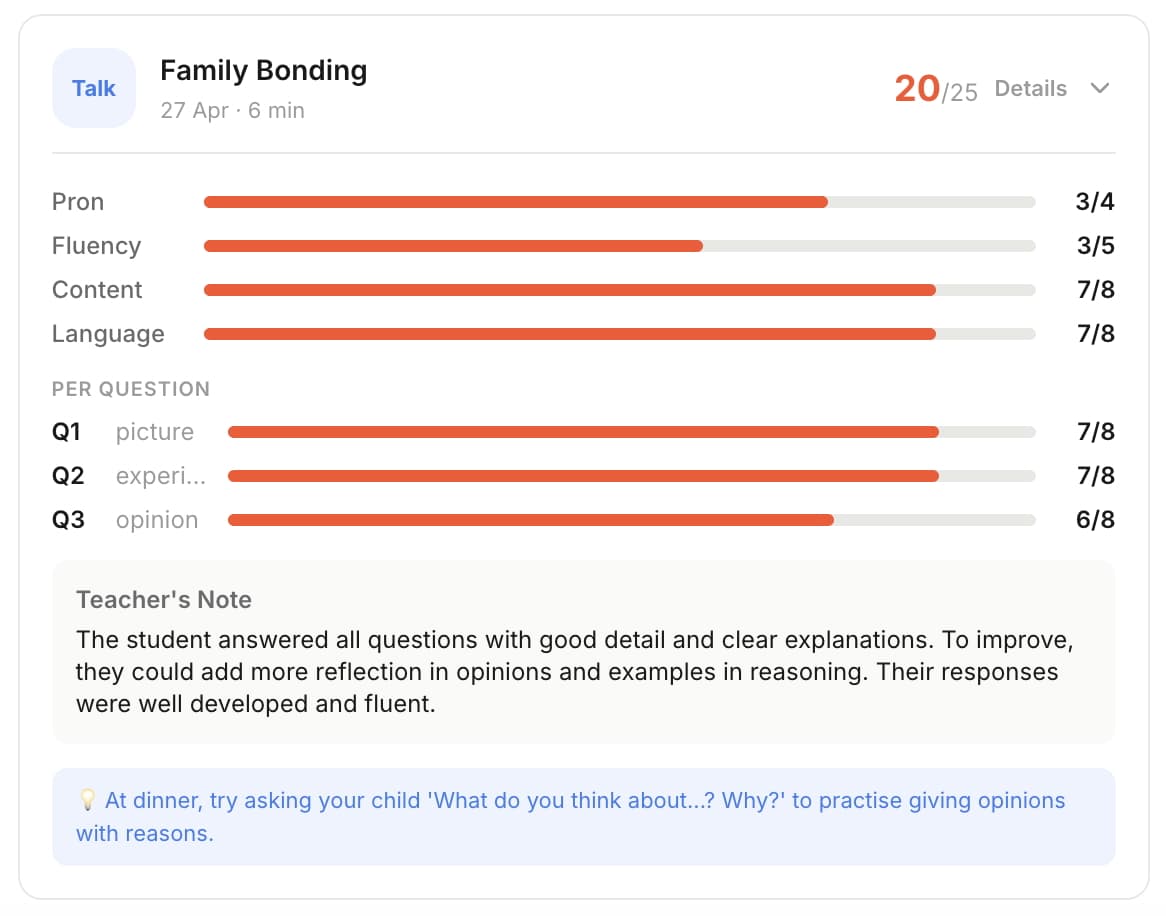
Example PSLEPrep Conversation scorecard
FAQ
Is PSLEPrep a cher.ai alternative?
PSLEPrep and cher.ai are both Singapore-built AI study companions for PSLE, and they overlap on Reading Aloud practice — so for many families, yes, they're alternatives. They diverge on everything else. PSLEPrep is oral-specialist (Reading Aloud + Conversation + Chinese 华文口试) and is the only one of the two that practises the stimulus-based Conversation (25 marks in English, 30 in Chinese). cher.ai pairs Reading Aloud with composition feedback (CompoCoach) and bundles access to Mind Stretcher workshops, but doesn't surface Chinese oral or Conversation practice on its public product pages.
Does cher.ai have Chinese (华文) practice?
Based on cher.ai's public product pages and pricing page as of May 2026, no — the surfaced product is English-only (composition + Reading Aloud). If 华文口试 is in your child's PSLE picture — and for the ~80% of Singapore P5/P6 students taking Chinese as a mother tongue, it is — you'll need a separate tool. PSLEPrep covers both English and 华文 in the same subscription, including 朗读, 看录像会话, 多音字 handling, and a bilingual UI throughout.
Does PSLEPrep practice the stimulus-based Conversation component?
Yes. The stimulus-based Conversation (25 marks in English, 30 in Chinese — called 看录像会话 in 华文) is where most P5/P6 students lose marks, and it's the component PSLEPrep was originally built around. The AI examiner shows a stimulus image or short video, asks the SEAB-format question, listens to your child's answer, follows up where a real examiner would, and produces a per-question scorecard at the end. cher.ai's public pages don't list a Conversation practice surface.
What's the price difference?
PSLEPrep is S$29.90/month, all-inclusive. cher.ai's Starter Preview was listed at S$25/month plus GST (about S$27.25/month after 9% GST) on the public pages we reviewed in May 2026, with notes that 'usage limits may apply' and 'preview access and pricing may change at Cher.ai's discretion'. cher.ai's subscription bundles access to Mind Stretcher's PSLE preparation workshops — a real value-add if you want in-person tuition adjacent to the software.
How does the free trial compare?
PSLEPrep gives you 10 free practice sessions with no credit card required — enough to try both Reading Aloud and Conversation, in both English and 华文, before deciding. cher.ai's 7-day trial requires a card upfront and is capped at 1 CompoCoach (composition) report and 3 Reading Aloud assessments. Both trials are limited; PSLEPrep's is more generous in raw session count and removes the card-upfront friction.
Which is better for Reading Aloud practice specifically?
Both tools are strong here. cher.ai has model audio recordings for every passage, phrasing/stress annotations above the passage text, and band 1–5 scoring on three dimensions (Pronunciation, Fluency, Expressiveness) mapped to the PSLE rubric. PSLEPrep now also gives a model audio recording for every English passage (so your child can listen for pace, pauses and expression first), scores per-dimension, and uses Microsoft Azure's pronunciation engine — which is excellent on a per-word and per-syllable basis. The one area cher.ai still edges ahead is phrase-level stress markers layered above the passage text, and our 华文 model audio is still rolling out. If Reading Aloud is the only oral component you care about and your child is English-medium, both are worth a serious look.
Why does PSLEPrep cover 华文口试?
Because in PSLE, the Chinese Oral component is worth 50 marks (25% of the Chinese grade) and Singapore is a bilingual education system. Building an English-only oral tool means leaving a large chunk of the exam — and a large chunk of Singapore families — uncovered. PSLEPrep treats English and 华文 as first-class siblings: same UI, same per-dimension scoring, same teacher's note pattern, same scorecard.
Sources & methodology
All claims about cher.ai are based on their public website (cher.ai), pricing page, and in-product screenshots reviewed in May 2026. Mark allocations and exam component descriptions follow SEAB / MOE 2025 PSLE syllabus documents. PSLEPrep claims describe the product as of the published date below. If you spot anything out of date, email hello@psleprep.sg and we’ll update.
Last checked: 11 May 2026 · Made in Singapore · psleprep.sg
See PSLEPrep in action
Take the free 2-minute oral diagnostic — get a personalised report in your inbox. Or grab the free study guides (English + 华文, no email required).