PSLE Oral parent guides.
Start with the right subject, check your child's readiness, then choose the guide or drill that fits tonight.
What are you preparing for?
What do you need right now?
This week — Oral prep focus
Where is my child losing PSLE Oral marks?
AL1–3 vs AL4–5 vs AL6–8 students lose marks for different reasons. Diagnose first, then drill the band-specific fixes that actually move the score.
What's the best PSLE Oral practice technique?
Record-and-playback. Children fix what they can hear, and most have never heard themselves read. The 5-minute daily protocol that beats unrecorded practice.
What are the top PSLE Chinese Oral tips for 2026?
Ten high-leverage tips from nine years of exam data — PEEL answer structure, 多音字 drilling, 你同意吗 preparation, the 20-minute daily routine, and what separates AL1 from AL3.
Start here
If you're new to PSLE Oral, read this first
How do I prepare for the PSLE Oral exam?
The pillar guide for both languages: exam structure, score-band diagnosis, frameworks, the daily routine, and the five mistakes parents make most often.
How do PSLE English and Chinese Oral compare on marks and rubrics?
After the 2025 English overhaul, the two orals are worth 90 marks combined — 40 for English, 50 for Chinese — and share the same five core scoring dimensions.
What is the format of PSLE Chinese Oral?
50 marks total — 20 for Reading Aloud (朗读篇章) and 30 for Stimulus-Based Conversation (会话). Two exam days in mid-August. Two examiners in the room.
Spot weak spots
Find where your child is losing marks before they become habits
My child speaks Chinese fluently — why is the oral score AL3?
Heritage-Chinese kids often score AL3 in oral despite speaking Chinese fluently. The reason is structural, not linguistic — and the fix is 4–6 weeks.
What are the most common PSLE English Oral mistakes — and how do we fix them tonight?
The 10 highest-cost PSLE English Oral mistakes — structure, content, pronunciation, exam-day — plus the fuller Reading Aloud and conversation lists, with one dinner-table fix for each.
What PSLE Chinese Oral mistakes can English-speaking parents spot?
Ten PSLE Chinese Oral mistakes framed for English-dominant parents — seven you can spot tonight with a stopwatch and an ear, three that need an AI scoring tool.
Show 3 more guides in this groupHide extra guides
What PSLE Chinese sentence-structure mistakes can English-dominant parents spot?
The structural Chinese errors you CAN spot — even if you don't read Chinese. The trace is in word order, not characters.
Where is my child losing PSLE Oral marks?
AL1–3 vs AL4–5 vs AL6–8 students lose marks for different reasons. Diagnose first, then drill the band-specific fixes that actually move the score.
How can I tell if my child is struggling in PSLE Chinese Oral?
Seven observable signs an English-speaking parent can spot — without assessing the Mandarin themselves. Which signs are home-fixable and which need outside help.
Understand what's tested
Format, scoring, what changed in 2025
What changed in PSLE English Oral 2025?
Five things changed: Oral is now 20% of the grade (up from 15%), Reading Aloud has the new PACT preamble, the conversation is on a real photograph, sub-prompts are gone (Q1 picture, Q2 experience, Q3 opinion), and Reading and Conversation are no longer linked.
What is the PEERS framework in PSLE English Oral?
PEERS — Point, Explain (or Experiences), Reflections (or Recommendation), Summarise — is the four-beat scaffold most tutors now teach for the 2025+ photograph-stimulus conversation.
What is the REAP framework for PSLE Oral Reading Aloud?
REAP — Rhythm, Expression, Articulation, Pace — is the four-beat structure most Singapore teachers now coach against for the 15-mark Reading Aloud section.
Show 5 more guides in this groupHide extra guides
What topics will appear in PSLE English Oral SBC 2026?
Five high-probability conversation topics for 2026, ranked: environmental responsibility, digital habits, kindness, school/community, and public behaviour.
Does my child need to read the news for PSLE oral?
No. PSLE oral SBC tests reasoning and personal examples — not current-affairs recall.
Why does my child keep using 'angry' and 'happy' in every composition?
AL3 children rotate the same six emotion words. AL1 children pick the precise word on the intensity gradient — annoyed, offended, furious, livid all mean "angry", but only one fits each sentence.
Is PSLE a bell curve?
No — PSLE AL is criterion-referenced. Each band is a fixed mark range (AL1 = 90+, AL2 = 85–89, etc.). Same mark, same band, every year.
What topics appeared in PSLE Chinese Oral 2026?
The 2026 topics as reported — Day 1 住家安全/邻里守望相助, Day 2 诚实/勇于认错 — set against ten years of exam data.
Practise tonight
Quick wins you can do at the dinner table
What should we do in the last week before Term 3 starts?
Use the final week of June holidays to run a 7-day PSLE Oral reset: baseline recording, reading-aloud checks, conversation-depth practice, one mock, and a clear July plan.
How should my child practise PSLE English Oral at home?
20 minutes a day — 10 minutes Reading Aloud with PACT decoding, 10 minutes Stimulus-Based Conversation using 5W1H for photograph prep and PEEL for the spoken answer.
How should my child practise PSLE Chinese Oral at home?
20 minutes a day — 10 minutes reading aloud, 10 minutes conversation practice from the high-frequency theme bank. Even non-Chinese-speaking parents can coach the structure.
Show 4 more guides in this groupHide extra guides
What is the dot-tap technique for PSLE oral reading aloud?
A 5-minute pacing drill: child taps the table at every full stop while reading aloud. Fixes the most common rubric-cost in two to three weeks.
Is daily 15-min practice really better than a 2-hour Saturday session for PSLE?
Most P6 parents stack weekend hours. The cadence is wrong-shaped — and the marathon analogy from a British Council tutor explains why.
What's the best PSLE Oral practice technique?
Record-and-playback. Children fix what they can hear, and most have never heard themselves read. The 5-minute daily protocol that beats unrecorded practice.
Is AI practice actually 'real' PSLE practice?
Reading model answers feels productive; it's mostly passive. Active recall — producing the answer cold — is what moves the score. Why PSLE Oral is the subject best suited to it, and why an AI examiner is active recall by design.
Last-mile prep
Final 4 weeks — what to do, what to skip
What are the top PSLE English Oral tips?
Ten tips for the 2025-format exam — reading the preamble, projecting the voice, expanding every answer, and the Singlish structures that reappear under pressure.
What are the top PSLE Chinese Oral tips for 2026?
Ten high-leverage tips from nine years of exam data — PEEL answer structure, 多音字 drilling, 你同意吗 preparation, the 20-minute daily routine, and what separates AL1 from AL3.
When should we start preparing for PSLE Oral?
Most parents start 3–4 weeks before — too late. The complete 12-week phased schedule: structural fixes, framework drilling, exam-condition consolidation, week-12 taper.
Coach without 中文
For English-dominant Singapore parents
How can I help my child if I don't speak Chinese?
You can train the structural habits PSLE examiners reward — in English, around the kitchen table. Three questions after every answer is the highest-leverage technique.
How can I coach PEEL in English if I don't speak Chinese?
PEEL is a thinking structure, not a vocabulary skill — drill it in English at the dinner table and the shape transfers to Chinese conversation answers.
How do I help my child with PSLE revision without becoming a tutor?
Ask questions, don't explain. Four rungs — recall, comprehension, application, evaluation — and a three-question rule for when to step in.
Shareable visuals
WhatsApp-friendly score examples, checklists, and practice plans.
Free tools and guides
Free PSLE Oral diagnostic
5 minutes. Real AI examiner. Real score. No credit card.
Start diagnosticToolPACT Practice
Same passage, different preambles. Practise tone-shifting for the 2025 English Oral format.
Practise PACTToolPicture Practice
Use 5W1H to practise photograph-based SBC questions in the 2025 English Oral format.
Practise picturesToolChinese Video Oral
Watch a short clip, then practise 看录像会话 questions in the current PSLE Chinese Oral format.
Practise video oralGuideFree PSLE Oral study guide
Bilingual PDF. Vocabulary banks. Sample answers. No email gate.
DownloadMore parent guides (31)
What were the past-year PSLE English composition topics?
Eleven years of PSLE Continuous Writing titles (2015–2025), where they come from, and a five-minute method for planning any of them.
What is the PSLE Chinese composition format, and how is it marked?
50 minutes, 40 marks, at least 100 characters, 命题作文 or 看图作文 — read from SEAB's syllabus, with Higher Chinese alongside and what SEAB does not publish.
Does my child need eye contact in PSLE English Oral?
Schools and tuition centres say opposite things. Answered from SEAB's published Assessment Objectives — the two halves of the paper genuinely differ.
What should my child do in the PSLE Oral preparation time?
About five minutes before the examiner begins, and most children spend it reading silently. Silent reading rehearses none of what is marked.
How many PSLE English Listening Comprehension questions use pictures?
The first 7 of PSLE English Listening Comprehension's 20 questions use pictures, not words — SEAB's own English syllabus guarantees it. The five picture-question types, and the one habit that decides most of these marks.
What does a top-band PSLE English Oral SBC answer actually look like?
Band 1 vs Band 3 PSLE English Oral SBC answer, side by side, annotated line by line. The four moves that take a 17/25 answer to 22-24/25.
What does a top-band PSLE Chinese Oral 会话 answer actually look like?
AL1 vs AL3 PSLE Chinese Oral conversation answer, side by side, annotated line by line. The four moves that take an 18/30 answer to 26/30.
How is PSLE English Oral scored? What do the 40 marks actually mean?
40 marks total: 15 for Reading Aloud, 25 for Stimulus-Based Conversation. SEAB publishes the totals but not the rubric — here's what's confirmed and what tuition centres infer.
How does my child handle PSLE examiner follow-up questions?
The first answer is rarely where marks are won. The five examiner probe types, the recovery templates that work for each, and how to build follow-up resilience.
How do we fix Chinese tones in non-Mandarin homes?
Tones are the killer in non-Mandarin-dominant homes. The shadowing protocol — listen, replay, copy syllable-by-syllable — fixes 第二声 / 第三声 confusion in 4–6 weeks.
Should I correct my child's mistakes during practice?
Mid-flow correction destroys fluency, which is itself worth marks. Separate practice into fluency mode (no interruption, ever) and correction mode (review after, on playback).
Will more vocabulary help my child's PSLE Oral score?
Probably not. The strongest students do not have the largest vocabularies — they sound calm, elaborate smoothly, and recover well. The contrarian case against vocabulary lists.
How many 成语 should my child memorise for PSLE Chinese Oral?
Five, deployed reflexively, beat fifty memorised but unused. The shortlist mapped to the highest-frequency PSLE conversation themes — with three sample sentences each.
How do we make PSLE Chinese 朗读 sound expressive, not flat?
朗读 is scored on four dimensions, not just accuracy. The four delivery levers — pace variation, pause placement, question intonation, dialogue voicing — and the 10-minute routine.
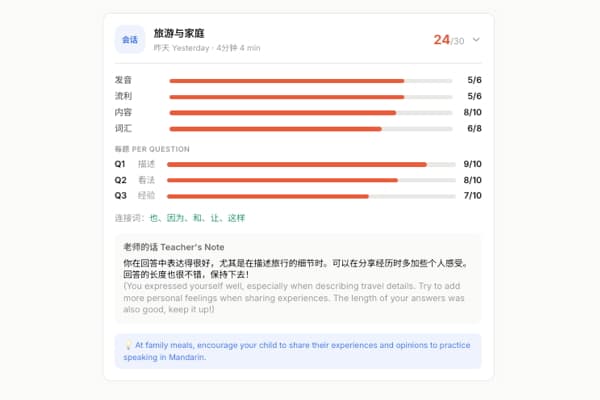
How is PSLE Chinese Oral scored? What do the 50 marks mean?
50 marks total: 20 for reading aloud, 30 for conversation. The biggest differentiator between AL1 and AL3 is answer depth, not pronunciation.
What does AL3 actually mean in PSLE Chinese Oral?
AL3 is not a single failure — it's five different patterns. The home-fixable ones take 4–6 weeks; the tone-endemic one is the only pattern that genuinely needs a tutor.
What are the most common mistakes in PSLE Chinese Oral?
Ten Singapore-specific patterns that consistently cost marks — flat 4th tones, missing tone sandhi on 一, one-line answers, code-switching, memorised templates.
Does the reading passage match the conversation video?
The SEAB Chinese syllabus is silent on whether the two components share a theme — there is no official guarantee. SEAB explicitly decoupled the English oral in 2025.
What are 多音字 and which ones matter for PSLE?
Polyphonic characters with multiple pronunciations. The highest-priority ones for PSLE are 得, 的, 地, 着, 为, 还 — they appear in almost every reading passage.
What are the past year PSLE English Oral topics?
Twelve years of PSLE English Oral photographs and conversation stimuli (2015–2026), ranked by frequency — including the 2026 topics as reported.
What does PSLE Chinese tuition cover, and is it worth it?
Tuition runs S$150–350/month in Singapore and is mostly built around the 65% of the grade that is written. Oral and listening are 35% — and they are the parts a group class can least help with.
Why are memorised Chinese answers failing in 2025?
SEAB examiners now ask 你同意吗 (Do you agree?) — a format that cannot be answered with a memorised template. In 2025, this format was confirmed on Day 1 across many Singapore schools.
What is the P.E.E.L. framework and how does it help in PSLE Oral?
Point, Explain, Example, Link — a four-step answer structure that works for both PSLE Chinese Oral opinion questions and the post-2025 English Oral Stimulus-Based Conversation.
How does PSLEPrep score PSLE Chinese Oral?
Audio analysis for pronunciation and AI language understanding for content — matching the PSLE examiner's four dimensions on the 50-mark rubric (20 reading + 30 conversation).
How does PSLEPrep score PSLE English Oral?
Microsoft Azure Speech for Reading Aloud (15 marks) and AI-scored conversation across the three-question arc — picture, experience, opinion (25 marks) — aligned to the post-2025 SEAB rubric.
What PSLE Oral topics have appeared over the last decade?
Twelve years of reported topics across both subjects, in one searchable database — now including the 2026 English and Chinese topics.
How should my child analyse the photograph in PSLE English Oral?
5W1H — Who, What, Where, When, Why, How — is the simplest checklist for the 5-minute prep window. The first three are observation, the last three force the inference skill the 2025 rubric rewards.
Which pronunciation mistakes cost the most marks in PSLE English Oral?
Six recur in almost every Singapore student — dropped ending consonants, flattened 'th', dropped past tense, collapsed vowels, reading too fast, and reading every passage in the same flat voice.
Why are memorised answers failing in PSLE Oral — both languages?
SEAB has reshaped both conversation components to defeat memorised model answers. English removed sub-prompts in 2025; Chinese examiners have been asking 你同意吗 since 2023.
What does 你同意吗 mean and why does it matter?
你同意吗 (nǐ tóngyì ma) means 'Do you agree?' Since around 2023, examiners frame conversation questions as opinion challenges that defeat memorised templates.
What is the PACT framework in PSLE English Oral?
PACT — Purpose, Audience, Context, Tone — is the new preamble at the top of every Reading Aloud passage from 2025. The student is expected to actively colour their reading to match.
About PSLEPrep
AI-powered PSLE Oral practice your child can do alone.
PSLEPrep covers both PSLE oral exams with an AI examiner that scores reading and adapts to your child's conversation answers — just like the real exam. S$29.90/month. No parent involvement required.