PSLE English Oral Study Guide · Chapter 4
The 5W1H Photograph Method: PSLE English Oral SBC Practice Worksheet
A printable 5W1H observation sheet and 10 on-page stimulus photographs your child can prep in the five minutes they get on exam day. Each image matches the scene description and includes three opinion questions in the 2025 SBC format.
The 5W1H observation sheet (fill in during 5-min prep)
Your child gets five minutes alone with the photograph before entering the exam room. This is the sheet they should fill in mentally — and practise on paper first until it becomes automatic. Print it, laminate it, stick it inside their practice folder.
WHO
How many people? Ages? Relationships? Are they together or separate?
WHAT
What are they doing? What objects are visible? What is the activity?
WHERE
Indoor or outdoor? What kind of place? What clues tell you (signs, buildings, natural features)?
WHEN
Time of day? Season? Weekday or weekend? Any sense of occasion?
WHY
Why are they doing this? What is their purpose? What might have led up to this moment?
HOW
How do they feel? What does their body language suggest? What mood is the photograph showing?
WHO-WHAT-WHERE-WHEN is observation. WHY-HOW is inference. The top band (21–25) comes from the inference half — spend longer on those two rows than on the first four.
The 5-minute prep routine (timed breakdown)
Five minutes sounds like plenty. Under exam pressure, it evaporates. This is the minute-by-minute routine that fits — drill it enough times and your child will feel it as a rhythm, not a checklist.
| Minute | What to do |
|---|---|
| 0:00–1:00 | Observe. Run through Who, What, Where, When. Just facts. Don't start interpreting yet. |
| 1:00–2:00 | Infer. Move to Why and How. What might the people be feeling? Why are they here? What does the mood of the photograph suggest? |
| 2:00–3:30 | Build opinions. Think about what opinion questions might come up. Form one stance for each likely angle. Don't write a full answer — just a position. |
| 3:30–4:30 | Personal hooks. Pick one personal experience that could be used as an example. Vivid detail, not a generic recount. |
| 4:30–5:00 | Recheck. Look at the photograph one more time. Check that you haven't missed anything obvious — a person in the background, an object off to one side. Take a breath. |
10 practice photographs + question sets
Each drill below includes the same photograph your child should study for five minutes, then three opinion-style questions in the 2025 format (no sub-prompts). You can open this page on a tablet or print the page if you prefer.

Photograph 1
A busy hawker centre at lunchtime
Multi-generational family sharing dishes at a crowded hawker centre. Steam rising from food. Grandparents, parents, two children.
- Q1. Why do you think families choose to eat at hawker centres together?
- Q2. Do you enjoy eating out with your family? Why or why not?
- Q3. Do you think traditional hawker food should be preserved as Singapore changes? Why?

Photograph 2
A child reading alone in a public library
A primary-school-aged child curled up in a beanbag reading a thick book. Rows of shelves in the background. Soft natural light.
- Q1. What do you think the child might be feeling, and why?
- Q2. What is your favourite kind of book to read, and why does it appeal to you?
- Q3. Do you think children today still need public libraries? Why or why not?
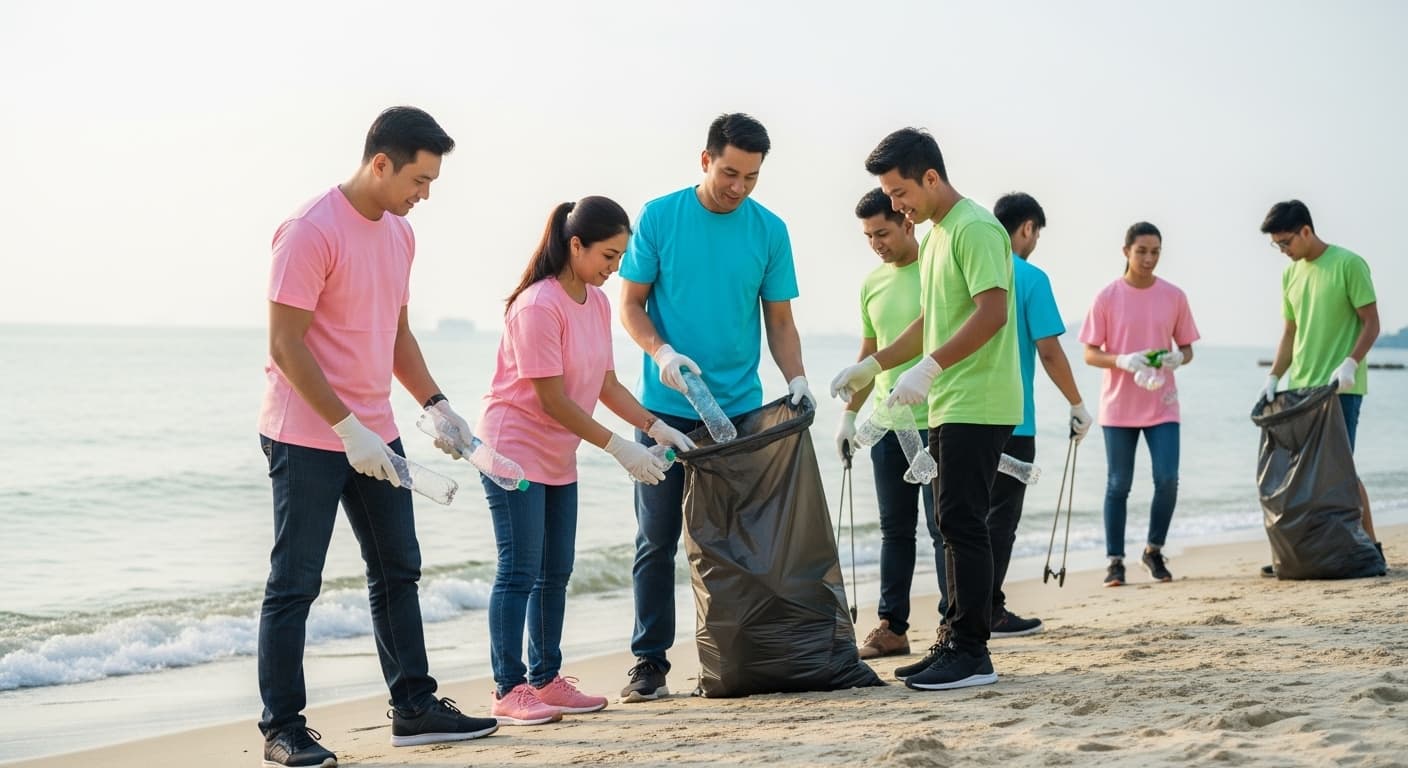
Photograph 3
A community clean-up at a beach
A group of volunteers in matching t-shirts picking up litter along a Singapore beach. Plastic bags, reusable gloves, signs visible.
- Q1. Why do you think these people decided to spend their morning doing this?
- Q2. Have you ever taken part in a community activity? Tell me about it.
- Q3. Do you think schools should make community service compulsory? Why?

Photograph 4
A student using AI on a tablet for homework
A primary school student sitting at a desk at home, tablet open with a generic assistant-style chat on screen (no readable words), exercise book beside it.
- Q1. What do you think the student is trying to do?
- Q2. Have you ever used technology to help you learn something new? Tell me about it.
- Q3. Do you think students should be allowed to use AI tools for their homework? Why?
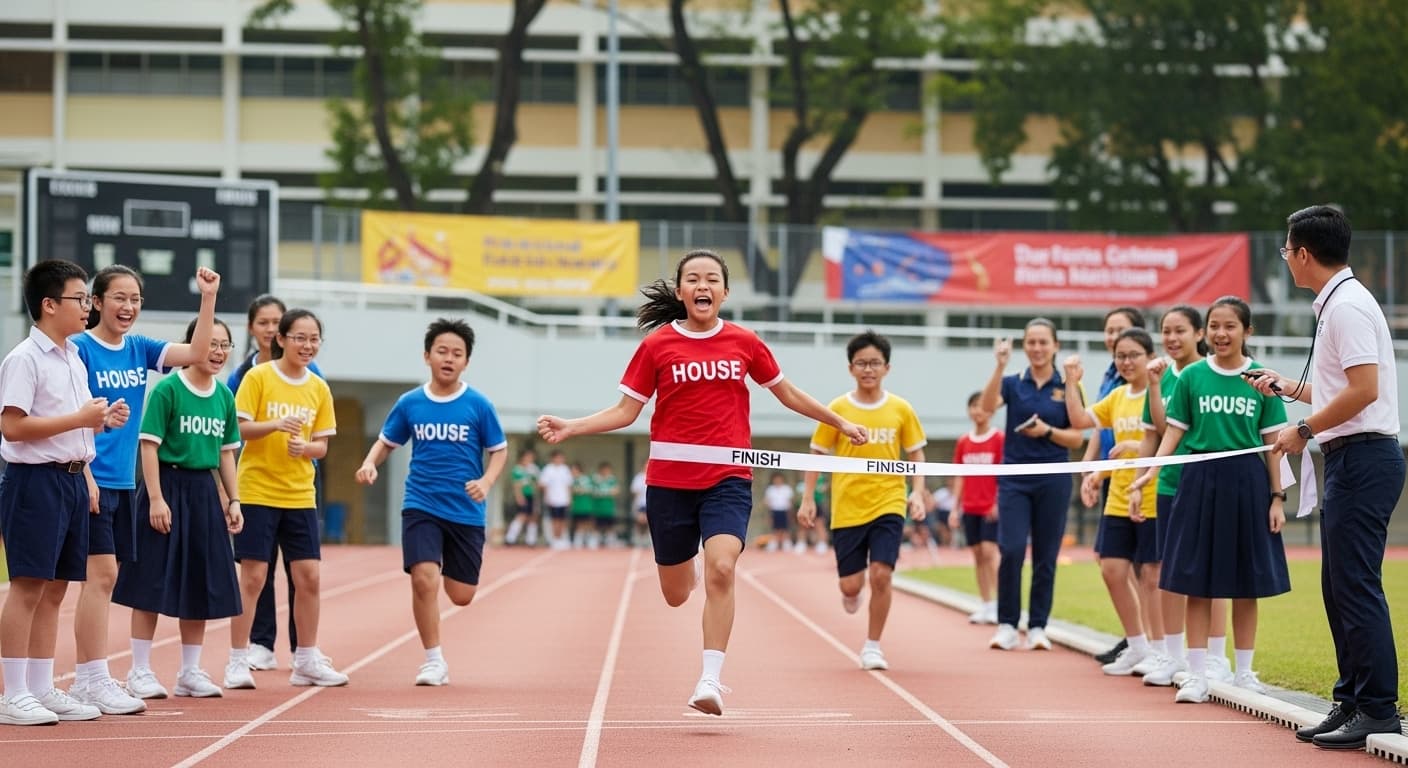
Photograph 5
A school sports day running race near the finish line
A runner sprints towards the finish line on a tartan track while classmates in house colours cheer from the sidelines. A teacher stands nearby with a stopwatch. Flags and banners in the background.
- Q1. How do you think the runners are feeling in this moment?
- Q2. Have you ever felt really proud of yourself after a competition? Tell me about it.
- Q3. Some people say children today spend too little time on sports. Do you agree?
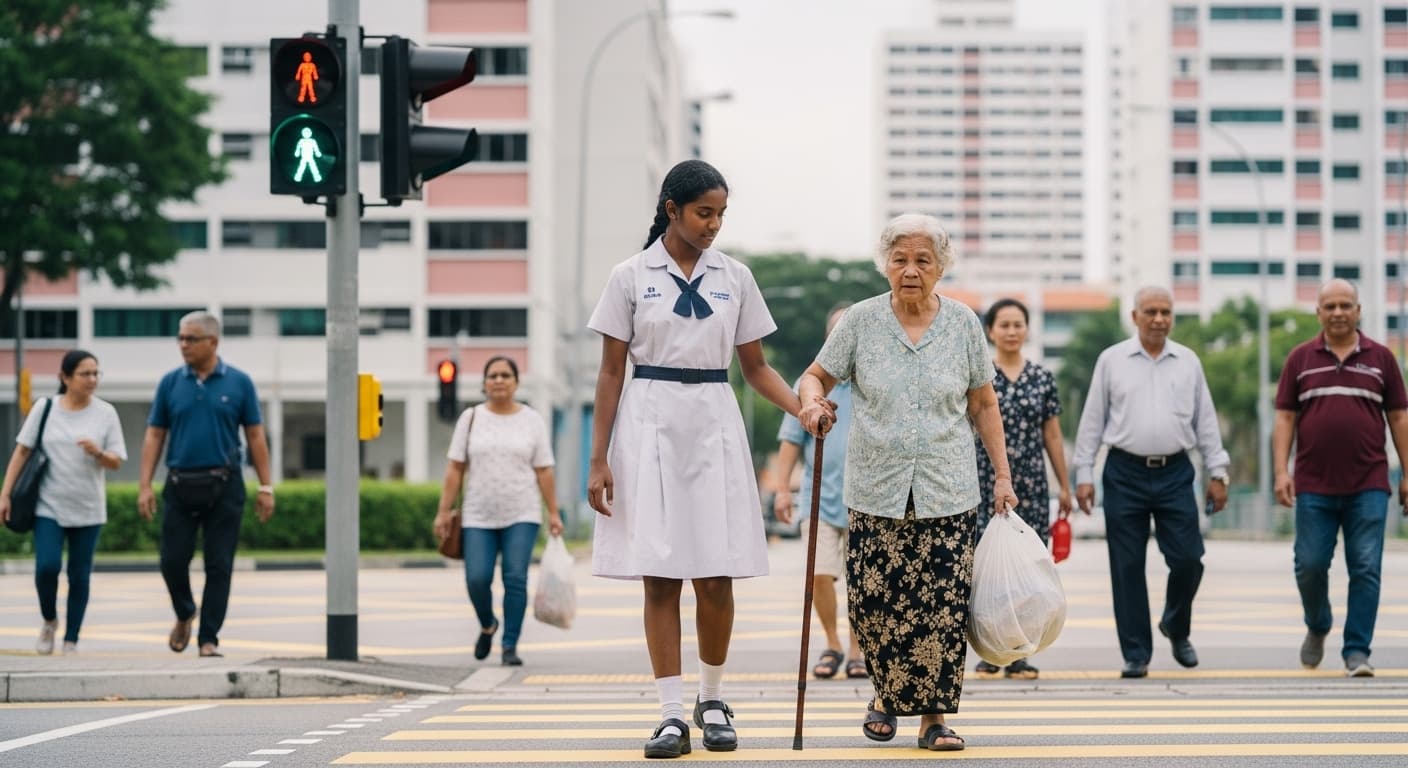
Photograph 6
An older person being helped across the road
A primary school student gently supports an elderly person with a walking stick at a pedestrian crossing, carrying shopping bags. Both are smiling. Other pedestrians and HDB blocks in the background.
- Q1. What do you think the student might be thinking in this moment?
- Q2. Have you ever helped someone you didn't know? Tell me about it.
- Q3. Do you think kindness to strangers is becoming more or less common in Singapore? Why?
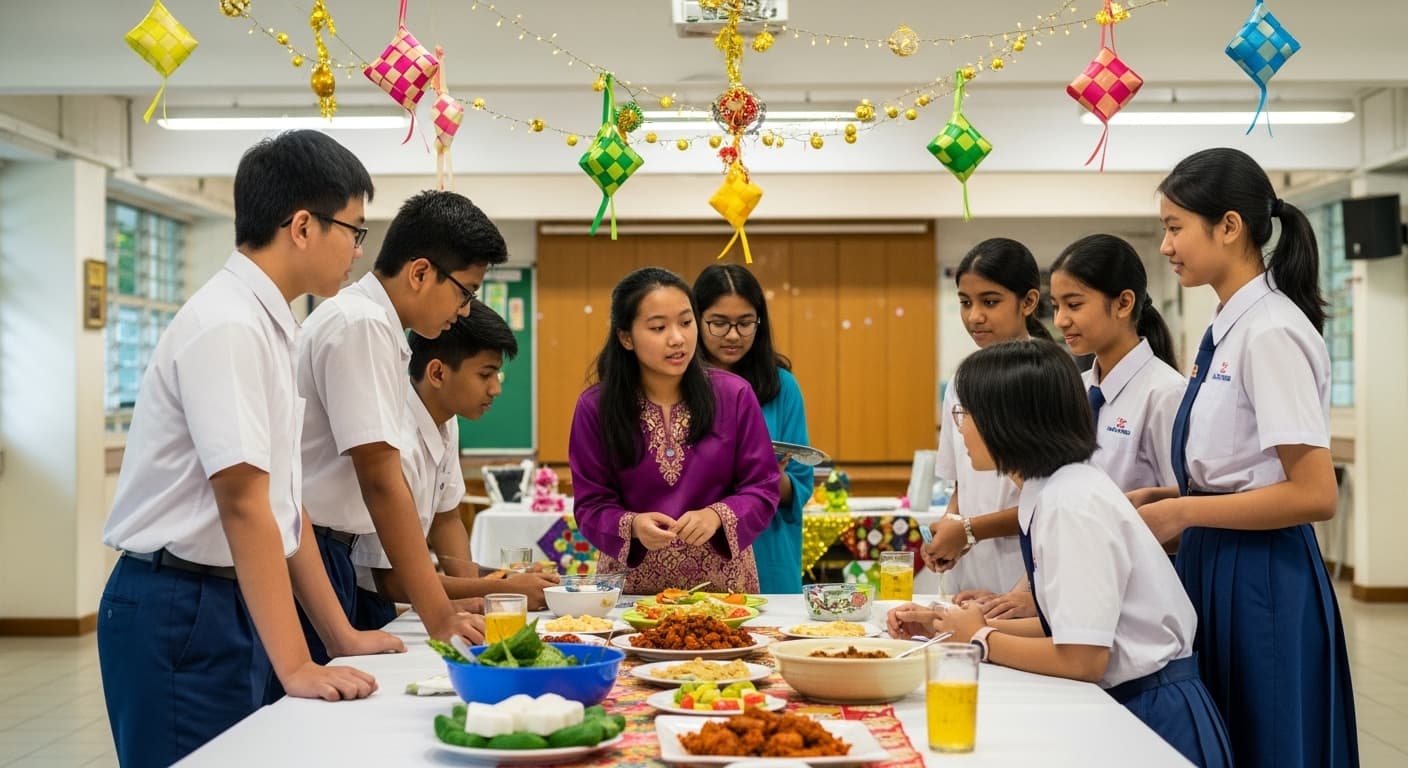
Photograph 7
A multi-racial group of children celebrating a festival
A school hall decorated for a festive celebration. Children of different ethnicities wear traditional outfits around a long table of shared food and treats. Decorations overhead; classmates share and explain dishes.
- Q1. Why do you think celebrating different cultures matters in Singapore?
- Q2. What is your favourite cultural festival, and why?
- Q3. Do you think young Singaporeans today know enough about different cultures? Why?
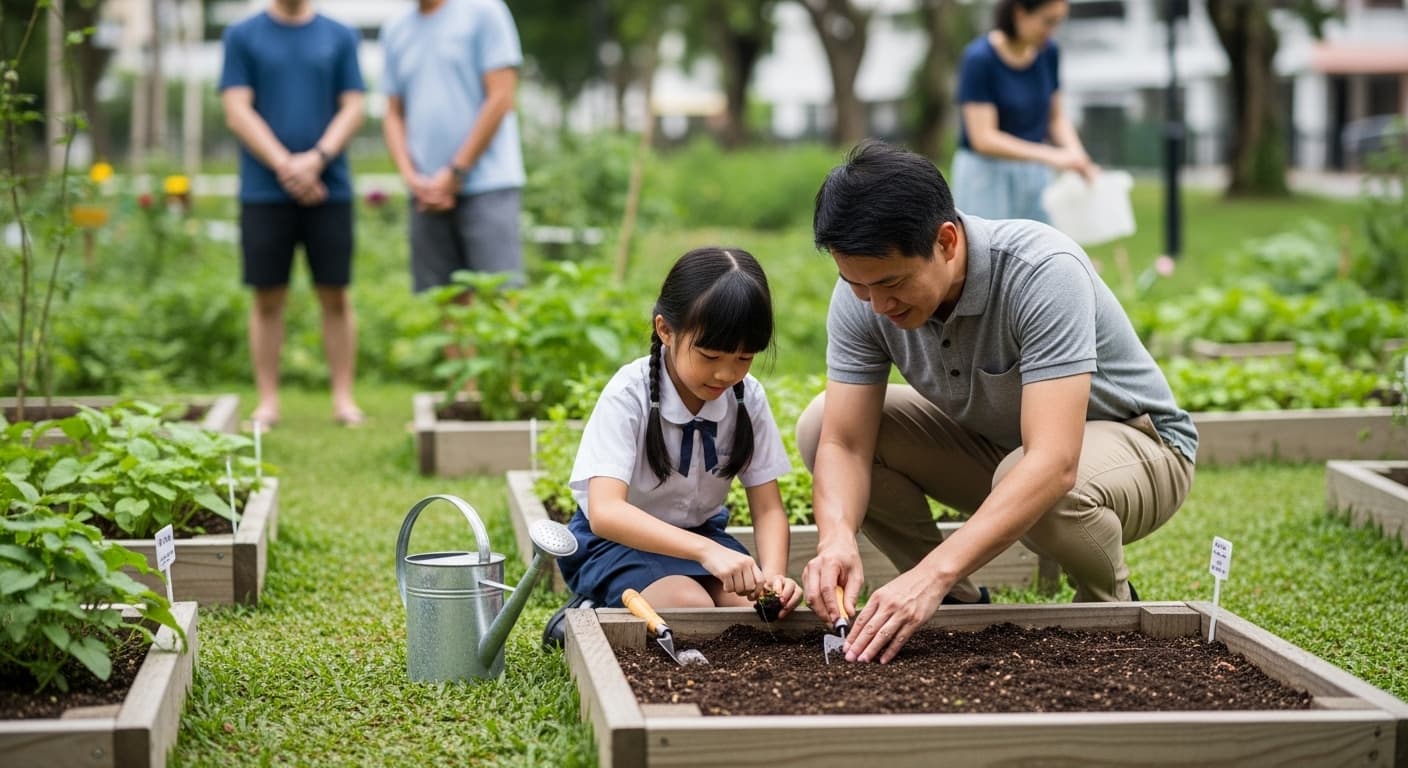
Photograph 8
A parent and child tending a community garden
A parent kneeling next to a child, planting a young seedling in a raised garden bed in a public park. Tools and watering cans nearby.
- Q1. What do you think the parent is trying to teach the child here?
- Q2. Have you ever grown or looked after a plant yourself? Tell me about it.
- Q3. Do you think more Singaporeans should try gardening? Why or why not?
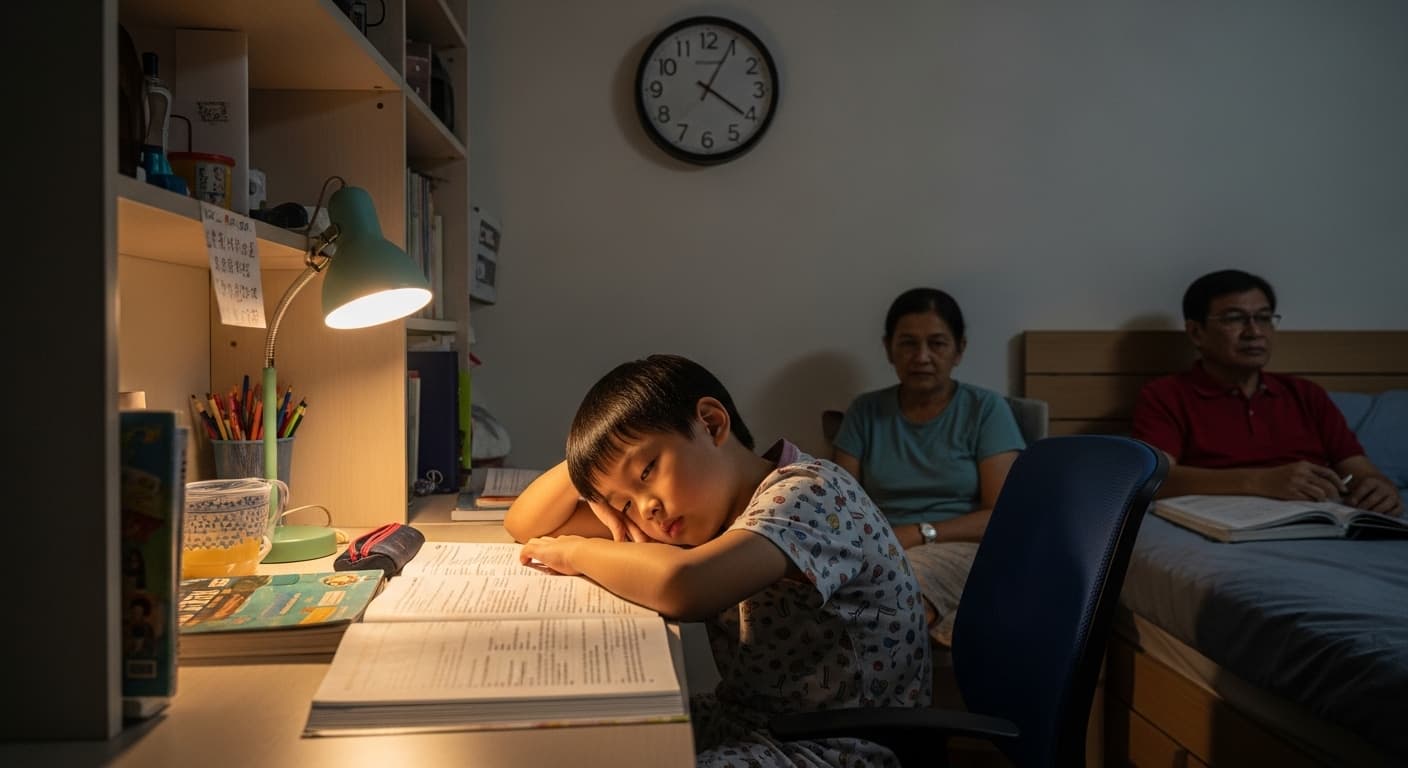
Photograph 9
A student looking tired late at night at a study desk
A primary school student at a study desk with books open, eyes half-closed, a clock on the wall showing a late hour.
- Q1. What do you think the student might be feeling, and why?
- Q2. How do you usually feel the night before a big test? Tell me about it.
- Q3. Do you think students today get enough sleep? Why or why not?
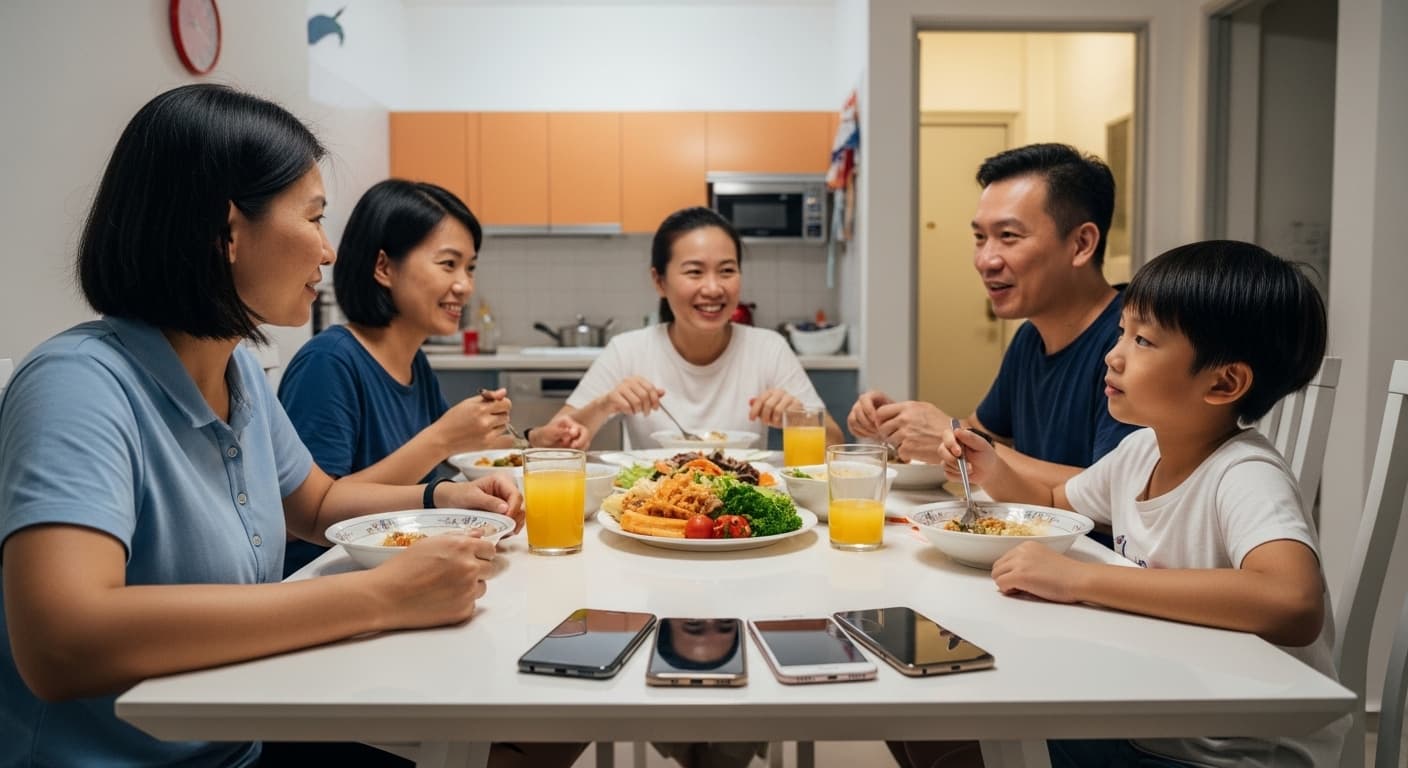
Photograph 10
A family eating together without phones
A family of four around a dining table, phones stacked face-down at the centre, dishes between them. Everyone is looking at each other.
- Q1. Why do you think this family has put their phones aside?
- Q2. In your family, when do you feel you connect the most? Tell me about it.
- Q3. Do you think technology has made it harder for families to spend time together? Why?
The PEEL answer builder (fill-in template)
For every conversation answer, your child should be building a four-part response. In practice, start by writing these out. Over a few weeks, it becomes the automatic shape of every spoken answer.
P — Point
Your clear answer or opinion. One sentence.
E — Elaborate
Your reason. Because… / This is because…
E — Example
A specific, personal example. Not generic.
L — Link
Connect back to the question, or broaden to a bigger idea.
How to score your child's answer (parent rubric)
Four simple dimensions. Tick one box per dimension after each answer. Score out of 8. A child averaging 6–8 across a session is on track for a strong band; 3–5 is the "average" band and is where most growth comes from.
| Dimension | What you're listening for | 0 | 1 | 2 |
|---|---|---|---|---|
| Observation | Did they describe what they see clearly, without rambling? | ☐ | ☐ | ☐ |
| Inference | Did they move beyond description to feelings, motivations, relationships? | ☐ | ☐ | ☐ |
| Personal example | Was the example specific and vivid — not a generic recount? | ☐ | ☐ | ☐ |
| Extension / link | Did they extend beyond the question — add an original thought or broader link? | ☐ | ☐ | ☐ |
Top mistakes to watch for during practice
- All description, no inference. "I see a boy eating ice cream. There is a queue. It is outdoors." This is a 13–17 band answer. Push for Why and How.
- Generic personal example. "I also like to eat with my family." Not specific enough. Push for a single moment with vivid detail — what day, who was there, what happened.
- Opinion without a reason. "Yes, I think kids should learn to cook." Then silence. Push for the Elaborate step every time — "because…"
- Rambling without a point. The opposite failure mode. Long, wandering answers that never actually state a position. Keep the Point step short and clear.
- Treating Q3 as if it's still about the photo. Q3 often has nothing to do with the image. It is a zoom-out opinion question. A child who keeps forcing the photograph back in will lose marks.
- Stilted, rehearsed phrasing. "In conclusion, firstly… secondly… thirdly…" — formal written English applied to a spoken conversation. Examiners penalise scripted-sounding answers. Aim for natural, slightly structured speech.
“Both my child and I enjoyed using your product for both languages.”
Get the full 9-page printable guide
The complete PSLE English Oral Study Guide — every chapter in one printable PDF. Format changes, PACT worksheets, SBC photograph drills, sentence starters, and the full 12-week countdown plan. Delivered to your inbox.
More from the study guide
Made in Singapore for Singapore families · © 2026 Studio P2 Pte Ltd