At a glance
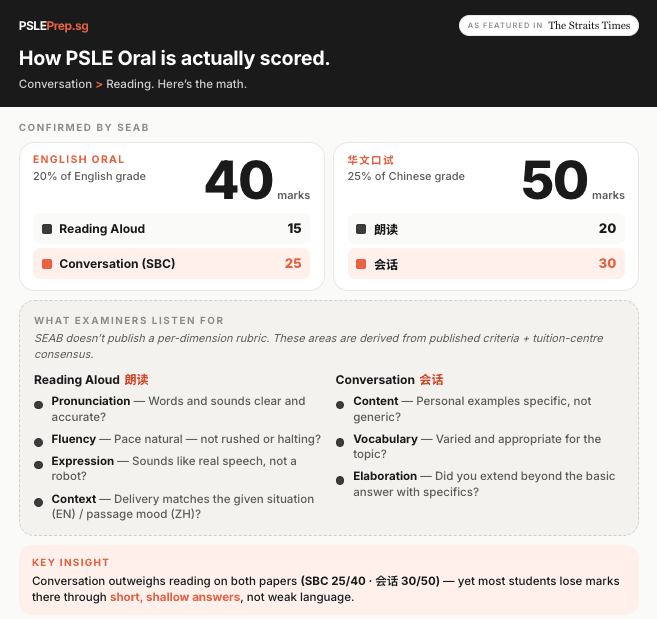
- English Oral is now 40 marks (20% of grade); Chinese Oral is 50 marks (25%) — together they outweigh any single written paper
- Both exams score the same 4 conversation dimensions: content, vocabulary, pronunciation, fluency
- Thinking skills (PEEL structure, elaboration, examples) transfer fully between languages
- Delivery skills (Chinese tones, English ending consonants, English 'given situation' tone-matching) must be drilled separately
- AL1 answers run 2–3× longer than AL3 — the extra length comes from specific detail, not padding
Combined, your child's two oral exams are now worth 90 marks — more than any single written paper. After the 2025 syllabus changes, PSLE English Oral is worth 40 marks (20% of the English grade, up from 15%); PSLE Chinese Oral is worth 50 marks (25% of the Chinese grade). For bilingual-stream families, understanding how the two rubrics line up is the highest-leverage piece of exam-prep planning you can do in P5 and early P6.
This guide sits the two rubrics next to each other so you can see — component by component — what the examiners are actually scoring, where the two exams overlap, and where they diverge. The headline: the thinking skills are almost identical, but the delivery skills are not.
How the two oral papers compare at a glance
| PSLE English Oral (2025+) | PSLE Chinese Oral | |
|---|---|---|
| Total marks | 40 marks | 50 marks |
| Share of language grade | 20% (up from 15% before 2025) | 25% |
| Reading Aloud marks | 15 marks | 20 marks · 朗读篇章 |
| Conversation marks | 25 marks (Stimulus-Based Conversation) | 30 marks · 会话 |
| Stimulus type | Photograph (no text) | Short video clip with a brief audible 旁白 (voice-over) that states the theme |
| Conversation questions | 3 main prompts — stimulus inference / personal experience / broader opinion (since 2025) | 3 main prompts — description / opinion / experience |
| Reading Aloud preamble | 'Given situation' line at top of passage (SEAB term, syllabus 0001) — purpose, audience, context. PACT mnemonic adds Tone as a 4th element. | None — read naturally |
| Thematic link | Reading and Conversation not linked | Loosely related in practice; not required |
Total marks
PSLE English Oral (2025+)
40 marks
PSLE Chinese Oral
50 marks
Share of language grade
PSLE English Oral (2025+)
20% (up from 15% before 2025)
PSLE Chinese Oral
25%
Reading Aloud marks
PSLE English Oral (2025+)
15 marks
PSLE Chinese Oral
20 marks · 朗读篇章
Conversation marks
PSLE English Oral (2025+)
25 marks (Stimulus-Based Conversation)
PSLE Chinese Oral
30 marks · 会话
Stimulus type
PSLE English Oral (2025+)
Photograph (no text)
PSLE Chinese Oral
Short video clip with a brief audible 旁白 (voice-over) that states the theme
Conversation questions
PSLE English Oral (2025+)
3 main prompts — stimulus inference / personal experience / broader opinion (since 2025)
PSLE Chinese Oral
3 main prompts — description / opinion / experience
Reading Aloud preamble
PSLE English Oral (2025+)
'Given situation' line at top of passage (SEAB term, syllabus 0001) — purpose, audience, context. PACT mnemonic adds Tone as a 4th element.
PSLE Chinese Oral
None — read naturally
Thematic link
PSLE English Oral (2025+)
Reading and Conversation not linked
PSLE Chinese Oral
Loosely related in practice; not required
SEAB does not publish detailed sub-score breakdowns for either exam. The dimension tables below are derived from syllabus documents and practice rubrics used across Singapore schools and tuition centres.
Compare your child against these rubrics
A 3-minute diagnostic for English or Chinese Oral
Choose a subject, record one short reading and one conversation answer, and get an instant rubric-based score for pronunciation, fluency, content, and structure. No sign-up.
Start the free diagnosticNo sign-up · No credit card · Instant score
Key takeaway
The conversation half is where most parents' preparation time is misallocated. In both exams, conversation outweighs reading (25 of 40 for English, 30 of 50 for Chinese) — yet most families spend most of their practice time on reading aloud. Rebalance and you reclaim marks fast.
What SEAB confirms — and what it doesn't
Before going further, it's worth being honest about what is officially published versus what is interpreted. For both exams, SEAB publishes:
- Total marks per component (Reading Aloud, Conversation) and the share of the overall language grade
- A short assessment objective (English AO1: "read fluently and expressively with clear and accurate pronunciation to suit purpose, audience and context"; Chinese: pronunciation, fluency, expression, accuracy)
- The broad format — passage + stimulus + three questions
SEAB does not publish:
- Per-dimension mark splits within Reading Aloud or Conversation
- Band descriptors or score thresholds for AL1, AL2, AL3 etc.
- Official names or labels for the three conversation question types
- The exact balance between content, language, pronunciation and fluency in the conversation score
Everything below the SEAB-confirmed numbers — the dimension tables, the AL band descriptors, the answer-length benchmarks — is interpreted from practice rubrics used across Singapore schools and tuition centres. The interpretation is broadly consistent across sources, but it is not the SEAB marking scheme. Treat it as a coaching framework, not as official truth.
Reading Aloud: the same 5 dimensions, with 1 key difference
Both exams assess pronunciation, fluency, expression, pace and accuracy. The English rubric adds given-situation tone-matching — the student must shift their delivery style to match the one or two sentences at the top of the passage describing purpose, audience and context (widely taught with the PACT mnemonic by Singapore tuition centres, who add Tone as a fourth element). The Chinese rubric adds tone accuracy (声调) — the four Mandarin tones must be correct throughout the passage, with special attention to common 多音字 traps.
| Dimension | English (/15) | Chinese (/20) |
|---|---|---|
| Pronunciation & articulation | Ending consonants ("gifts", "project"), /th/ sounds, vowel accuracy | Tones (声调), 多音字, clear articulation of pinyin |
| Fluency & rhythm | Natural phrase groups, smooth recovery from stumbles | Smooth delivery, pausing at punctuation, natural pace (流利) |
| Expression & intonation | Pitch variation, emphasis on key words, emotion matching content | Emotion matching content, rising intonation for questions (语调/表情达意) |
| Pace | Not too fast, not too slow; appropriate pausing | Not too fast, not too slow; appropriate pausing |
| Accuracy | Not skipping, substituting, or adding words | Not skipping, substituting, or adding characters (准确) |
| Matching the given situation | NEW since 2025 — delivery must match the purpose/audience/context line at the top of the passage | Not assessed separately |
Pronunciation & articulation
English (/15)
Ending consonants ("gifts", "project"), /th/ sounds, vowel accuracy
Chinese (/20)
Tones (声调), 多音字, clear articulation of pinyin
Fluency & rhythm
English (/15)
Natural phrase groups, smooth recovery from stumbles
Chinese (/20)
Smooth delivery, pausing at punctuation, natural pace (流利)
Expression & intonation
English (/15)
Pitch variation, emphasis on key words, emotion matching content
Chinese (/20)
Emotion matching content, rising intonation for questions (语调/表情达意)
Pace
English (/15)
Not too fast, not too slow; appropriate pausing
Chinese (/20)
Not too fast, not too slow; appropriate pausing
Accuracy
English (/15)
Not skipping, substituting, or adding words
Chinese (/20)
Not skipping, substituting, or adding characters (准确)
Matching the given situation
English (/15)
NEW since 2025 — delivery must match the purpose/audience/context line at the top of the passage
Chinese (/20)
Not assessed separately
Cross-language lesson
Fluency, expression and pace habits transfer fully. A child who reads Chinese in a lively voice already has the muscle to do the same in English — they just need to drill reading the same passage with different given situations so the shift in tone is deliberate, not accidental. Pronunciation and tones do not transfer: Chinese tones and English ending consonants are language-specific and need dedicated practice in each.
Conversation: where the two exams are closest
The conversation component is the single biggest overlap between the two exams. Both carry more marks than the reading component (25 of 40 for English; 30 of 50 for Chinese). Both score the same four dimensions. And in both cases, the most common reason students score AL3 instead of AL1 is not weak language — it is shallow answers.
| Dimension | English (/25) | Chinese (/30) |
|---|---|---|
| Content & elaboration | Reasons + examples + personal connections; specific detail on the experience question (Q2); no one-line answers | Reasons + examples + personal connections; specific detail on the experience question; no one-line answers (内容充实) |
| Vocabulary & expression | Topic-appropriate vocabulary, variety of sentence structures, connectors | Same — plus register (formal 书面语 vs conversational) (词汇运用) |
| Pronunciation | Same standards as Reading Aloud applied to spontaneous speech | Accurate tones throughout spontaneous speech; no repeated mispronunciations |
| Fluency & delivery | No long pauses, no fillers ("um", "like", "you know"), confident delivery | No long pauses, no filler sounds, confident delivery (表达流利度) |
Content & elaboration
English (/25)
Reasons + examples + personal connections; specific detail on the experience question (Q2); no one-line answers
Chinese (/30)
Reasons + examples + personal connections; specific detail on the experience question; no one-line answers (内容充实)
Vocabulary & expression
English (/25)
Topic-appropriate vocabulary, variety of sentence structures, connectors
Chinese (/30)
Same — plus register (formal 书面语 vs conversational) (词汇运用)
Pronunciation
English (/25)
Same standards as Reading Aloud applied to spontaneous speech
Chinese (/30)
Accurate tones throughout spontaneous speech; no repeated mispronunciations
Fluency & delivery
English (/25)
No long pauses, no fillers ("um", "like", "you know"), confident delivery
Chinese (/30)
No long pauses, no filler sounds, confident delivery (表达流利度)
The question formats differ — English uses three prompts arcing from photograph-anchored inference (Q1) through personal experience (Q2) to broader opinion (Q3); Chinese uses a description / opinion / personal-experience arc about a short video — but the answer structure that wins marks is the same in both: the P.E.E.L. framework (Point, Explain, Example, Link).
How long should a strong answer be in each language?
AL1 answers in both languages run roughly twice as long as AL3 answers. The extra length comes from specific detail — not from padding. These benchmarks are derived from practice rubrics and are a guide, not an official SEAB allocation.
| Question type | Weak (AL3–4) | Strong (AL1–2) |
|---|---|---|
| English Q1 — Picture inference | <20 words. Names one thing in the photograph. | 40–60 words. Describes what is happening + who is involved + an inferred feeling or motivation. |
| English Q2 — Personal experience | <20 words. "Yes, I went before." — no when, no where, no what happened. | 60–80+ words. A specific incident with time, place, people, what happened, and how it felt. |
| English Q3 — Opinion | <25 words. Yes/no + one vague reason. | 60–80+ words. Clear stance + reason + specific example + link to broader value. |
| Chinese Q1 — 描述 (describe video) | <30 characters. 1–2 sentences, missing who/where/why. | 60–80+ characters. Covers who, what, where, when, emotions. |
| Chinese Q2 — 表达意见 (opinion) | 「我觉得很好。」 ~10–15 chars. No reason or example. | 60–100+ characters. Clear opinion + reason + example + connector. |
| Chinese Q3 — 分享经历 (experience) | 「有,我有过。」 ~8–10 chars. No story. | 60–100+ characters. Specific story with when, where, what happened, feelings. |
English Q1 — Picture inference
Weak (AL3–4)
<20 words. Names one thing in the photograph.
Strong (AL1–2)
40–60 words. Describes what is happening + who is involved + an inferred feeling or motivation.
English Q2 — Personal experience
Weak (AL3–4)
<20 words. "Yes, I went before." — no when, no where, no what happened.
Strong (AL1–2)
60–80+ words. A specific incident with time, place, people, what happened, and how it felt.
English Q3 — Opinion
Weak (AL3–4)
<25 words. Yes/no + one vague reason.
Strong (AL1–2)
60–80+ words. Clear stance + reason + specific example + link to broader value.
Chinese Q1 — 描述 (describe video)
Weak (AL3–4)
<30 characters. 1–2 sentences, missing who/where/why.
Strong (AL1–2)
60–80+ characters. Covers who, what, where, when, emotions.
Chinese Q2 — 表达意见 (opinion)
Weak (AL3–4)
「我觉得很好。」 ~10–15 chars. No reason or example.
Strong (AL1–2)
60–100+ characters. Clear opinion + reason + example + connector.
Chinese Q3 — 分享经历 (experience)
Weak (AL3–4)
「有,我有过。」 ~8–10 chars. No story.
Strong (AL1–2)
60–100+ characters. Specific story with when, where, what happened, feelings.
The pattern is consistent across both languages: AL1 conversation answers are 2–3× the length of AL3 answers, and the extra material is specific (a real queue at a real hawker centre, a named friend, a concrete number) rather than general. Memorised templates fail precisely because they cannot be specific on demand — the examiner hears the same phrases every candidate uses and discounts them.
Parent tip
What AL1, AL2, and AL3 look like in both exams
| Band | English Oral profile | Chinese Oral profile |
|---|---|---|
| AL1 | Actively adjusts reading tone to match the given situation at the top of the passage. Gives extended opinion answers with a clear stance, specific example, and broader link. No Singlish fillers. | Accurate tones throughout natural expression; rising intonation for questions; extended answers with reasons, examples, and topic vocabulary; requires no prompting. |
| AL2 | Some attempts to shift tone for the given situation; clear opinion answers with some elaboration; minor pronunciation slips on difficult words. | Mostly accurate; minor tone errors on uncommon characters; clear answers with some elaboration; minimal prompting needed. |
| AL3 | Reads every passage in the same flat voice regardless of the given situation. Short answers with vague reasons; some Singlish or filler words; no specific examples. | Several tone errors; noticeable pauses; adequate but flat expression; short conversation answers; needs prompting to extend answers. |
AL1
English Oral profile
Actively adjusts reading tone to match the given situation at the top of the passage. Gives extended opinion answers with a clear stance, specific example, and broader link. No Singlish fillers.
Chinese Oral profile
Accurate tones throughout natural expression; rising intonation for questions; extended answers with reasons, examples, and topic vocabulary; requires no prompting.
AL2
English Oral profile
Some attempts to shift tone for the given situation; clear opinion answers with some elaboration; minor pronunciation slips on difficult words.
Chinese Oral profile
Mostly accurate; minor tone errors on uncommon characters; clear answers with some elaboration; minimal prompting needed.
AL3
English Oral profile
Reads every passage in the same flat voice regardless of the given situation. Short answers with vague reasons; some Singlish or filler words; no specific examples.
Chinese Oral profile
Several tone errors; noticeable pauses; adequate but flat expression; short conversation answers; needs prompting to extend answers.
Efficiency gain
Most of the content and structure work can be done once, in whichever language your child is more comfortable with, and the benefit shows up in both exams. The delivery work — tones for Chinese, ending consonants and given-situation tone-matching for English — has to be drilled separately.
What transfers, and what doesn't
For bilingual-stream students, the question that matters most is: which of my hours of practice in one language count toward the other? Here is the honest answer — some skills transfer fully, some transfer partly, and some not at all.
Fully transfers
- Point-making habit
- Supporting with a reason
- Giving a specific example
- Linking to broader values
- PEEL structure
- Not memorising answers
- Listening to the question carefully
Partly transfers
- Fluency and pace habits
- Expression and intonation
- Confident delivery
- Vocabulary breadth (thematic ideas, not words)
- Recovery from stumbles
Does not transfer
- Chinese tones (声调)
- English ending consonants (/s/, /t/, /d/)
- 多音字 knowledge
- English /th/ sound
- Subject-specific connectors
- Given-situation tone-matching
The practical implication: most of the content and structure work can be done once, in whichever language your child is more comfortable with, and the benefit shows up in both exams. The delivery work — tones for Chinese, ending consonants and given-situation tone-matching for English — has to be drilled separately. For families new to this, the 2015–2025 topics database shows which theme clusters appear in both exams, so you can choose practice topics that compound across subjects.
One login, both rubrics
10 free practice sessions on either rubric
An AI examiner runs the full English Oral or Chinese Oral format, scores against the dimensions in this guide, and gives band-descriptor feedback so you know exactly where your child sits between AL1 and AL3.
Start 10 free practice sessionsNo sign-up · No credit card · Instant score
Further reading
- The 2025 PSLE English Oral overhaul explained — every change in one place
- PSLE Chinese Oral scoring — the deep-dive on the Chinese rubric
- The P.E.E.L. framework — one answer structure for both PSLE Chinese and English Oral
- The PACT mnemonic — how Singapore tutors teach the new English Reading Aloud given situation
- Why memorised oral answers fail in both languages
- PSLE Oral topics database 2015–2025 — pick practice topics that compound
- PSLE Chinese Oral tuition vs self-practice — cost, speaking time, and the hybrid that wins