What the examiner sees
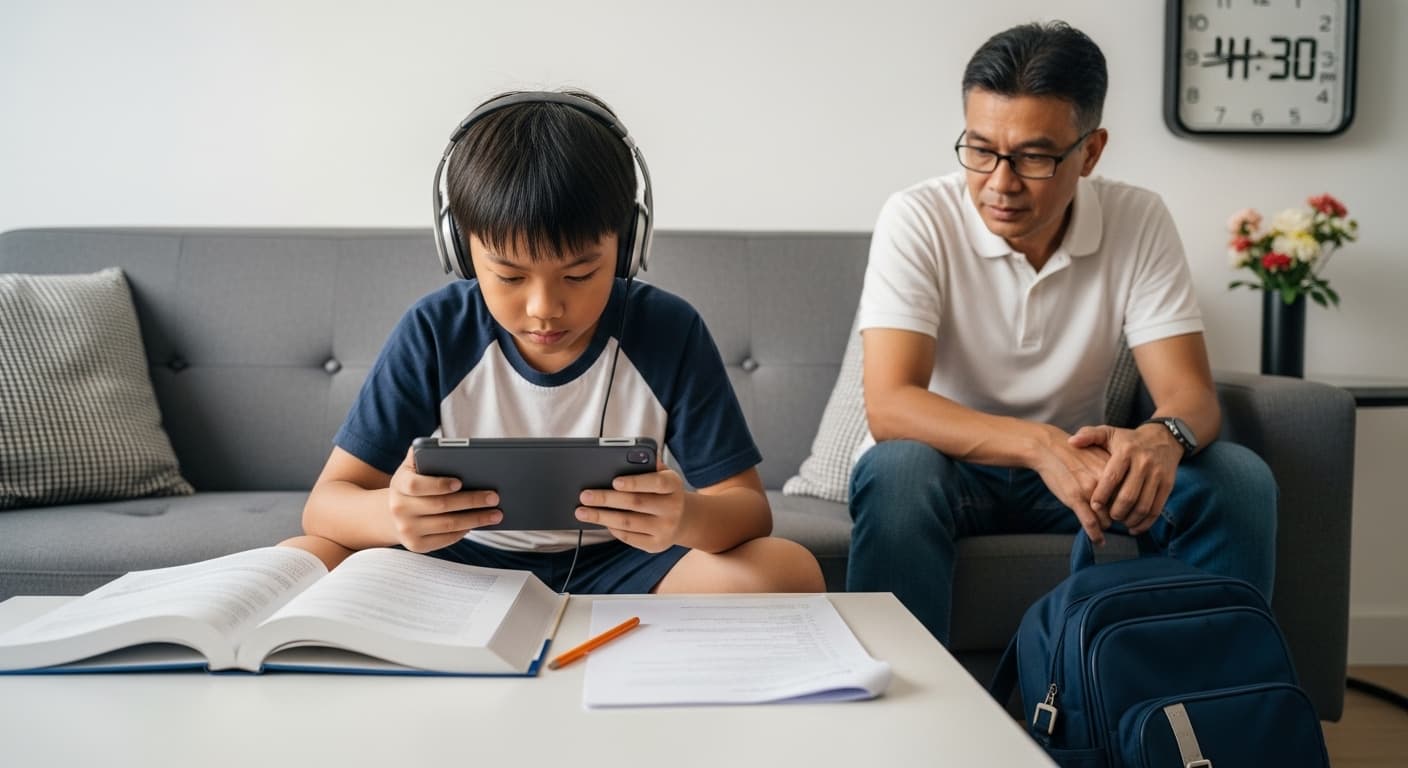
Photograph description
The photograph shows a boy around 11 years old sitting on a sofa at home. He is playing a game on his tablet, wearing headphones. On the table next to him, there is an open textbook and an unfinished homework sheet. A clock on the wall shows 4:30 pm. His school bag is on the floor nearby.
Three questions the examiner might ask
What do you notice in this photograph? What do you think the boy should be doing?
How do you manage your time between homework and using devices? Tell me about your routine.
Do you think children your age spend too much time on digital devices? What would you suggest to help children use devices more wisely?
Q1 tests what you see in the photograph. Q2 tests a personal experience. Q3 tests your opinion — the hardest of the three since 2025.
A model opinion answer (P.E.E.L.)
Point
I don't think children my age always spend too much time on devices — it really depends on what they're using devices for.
Explain
Playing games for three hours is different from using a learning app or video-calling my cousin in Malaysia.
Example
In my family, we have a rule: no games before homework is done, but educational apps and reading on the iPad are allowed any time. My younger sister uses Khan Academy for maths every day, which is a good two hours of screen time — but it's productive.
Link
So the real question isn't how much screen time, but what kind — and that's a conversation families should have together.
Swap in your own example — the structure stays the same. Examiners reward concrete detail over polished phrasing.
Common mistakes on this topic
- Saying 'I don't use devices much' when the examiner can tell otherwise. Be honest and talk about how you manage it.
- Treating 'technology' as one thing. Tablets, games, messaging, and AI are all different — pick one.
- Skipping the actual rule or habit your family uses. Concrete rules score higher than wishful thinking.
Vocabulary that works for this topic
device— a piece of technology
“I use three devices every day.”
balance— the right mix
“It's about balance between work and play.”
distraction— something that pulls your attention
“Games can be a big distraction.”
productive— getting useful things done
“The app helped me be more productive.”
addictive— hard to stop
“Some games are very addictive.”
innovation— a new idea or product
“Innovation has made learning more fun.”
For parents
Pick up any family device and ask your child to describe what a 'good hour' and a 'bad hour' of screen time look like, using that specific device. That exact framing is what Q3 is testing.
Practise this topic now
Run a full Stimulus-Based Conversation on “Digital Devices” with an AI examiner.
Three real opinion questions, instant scoring on the 2025 SEAB rubric, and a parent-friendly breakdown of what to improve. Free for your first 10 sessions.
Practise this topic freeSign in takes 10 seconds · No credit card
More topics in Technology & Innovation
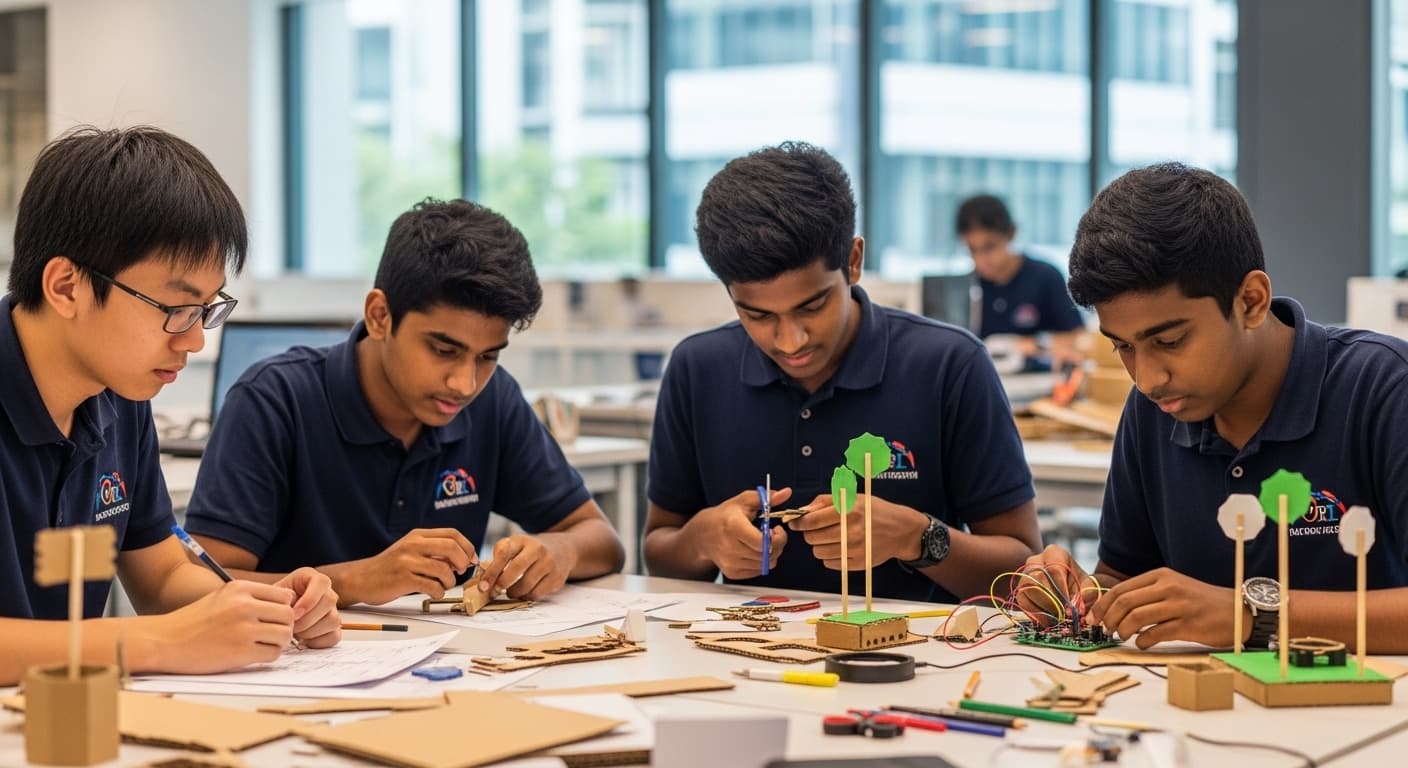
Creative Thinking
Creativity and maker-space SBCs reward specificity about the project — not about creativity in the abstract. Name what your team actually built and what went wrong.
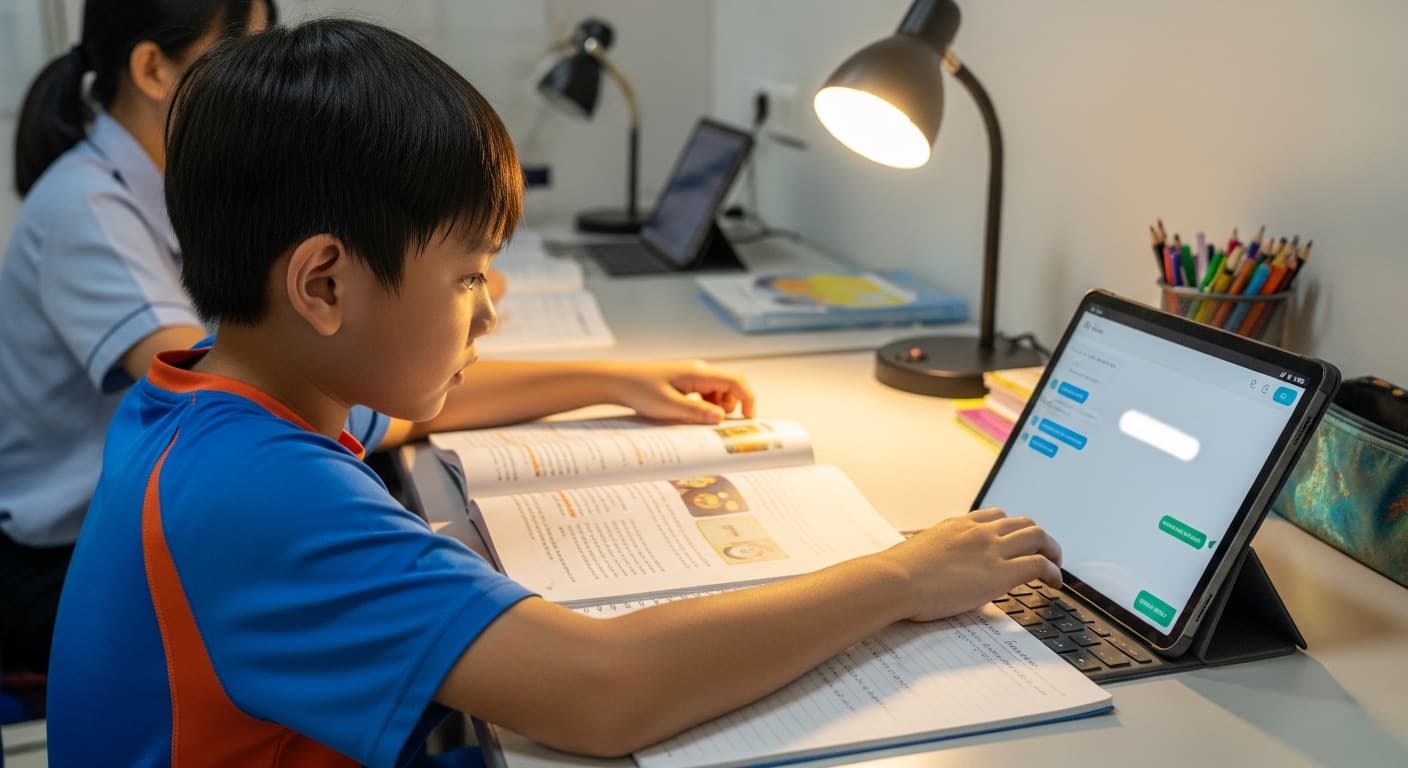
Using AI to Learn
AI-in-learning Q3 asks students to draw the line between 'help' and 'cheat'. The answer that defines the line concretely — 'AI explains, I still write' — scores higher than one that dodges the tension.

Too Much Screen Time
Screen-time Q3 asks whether devices make children lonelier. A 'sometimes yes, sometimes no' answer works only if it names WHEN each is true — specificity wins.