
What the examiner sees
Photograph description
The photograph shows a boy at a school swimming pool during a competition. He is in the water, clearly tired, and slightly behind the other swimmers. On the poolside, his teammates and coach are cheering him on with encouraging gestures. A timing board shows the race is almost over. The boy's face shows determination despite his exhaustion.
Three questions the examiner might ask
What is happening in this photograph? How can you tell the boy is finding the race difficult?
Tell me about a time when you wanted to give up on something but kept going. What helped you persevere?
Some people believe that talent matters more than hard work. Do you agree, or do you think perseverance is more important? Why?
Q1 tests what you see in the photograph. Q2 tests a personal experience. Q3 tests your opinion — the hardest of the three since 2025.
A model opinion answer (P.E.E.L.)
Point
I think honesty matters most in friendships, even when it's uncomfortable.
Explain
A friend who only says nice things eventually becomes a stranger, because you can't rely on their view.
Example
Last year, my best friend told me my English oral practice answer was too short and not specific. I was upset at first, but I rewrote it using her feedback. I ended up scoring better in the mock than she did.
Link
So her honesty wasn't just helpful — it's the reason I trust her more now than before. That's what a good friend does.
Swap in your own example — the structure stays the same. Examiners reward concrete detail over polished phrasing.
Common mistakes on this topic
- Saying 'honesty is important' three ways. Name a consequence — what happens in a school or family without honesty?
- Describing a perfect friendship without any difficulty. Real friendships have moments where honesty is hard.
- Confusing a generic friend with a specific friend. Q2 asks for a real person and a real story.
Vocabulary that works for this topic
honest— truthful
“An honest apology is always appreciated.”
respect— treating others well
“I show respect to my elders.”
integrity— doing the right thing quietly
“She has a lot of integrity.”
gratitude— feeling thankful
“I showed gratitude by writing a card.”
supportive— helping others
“My friend is very supportive.”
trust— belief in someone
“Trust takes years to build.”
For parents
Ask 'What's the hardest thing you've ever had to be honest about?' — and then stay quiet. The story that comes out is usually the gold that Q3 is looking for.
Practise this topic now
Run a full Stimulus-Based Conversation on “Never Give Up” with an AI examiner.
Three real opinion questions, instant scoring on the 2025 SEAB rubric, and a parent-friendly breakdown of what to improve. Free for your first 10 sessions.
Practise this topic freeSign in takes 10 seconds · No credit card
More topics in Values, Manners & Friendship

Caring for the Elderly
Elderly-care SBCs test values through inference. Start by naming the small, thoughtful gesture in the photo, then anchor the opinion answer in a real grandparent or neighbour.

A Good Friend
Friendship SBCs let students bring a specific friend into the answer. A one-line story about a real friend who helped you scores higher than any vocabulary bank.
Being Honest
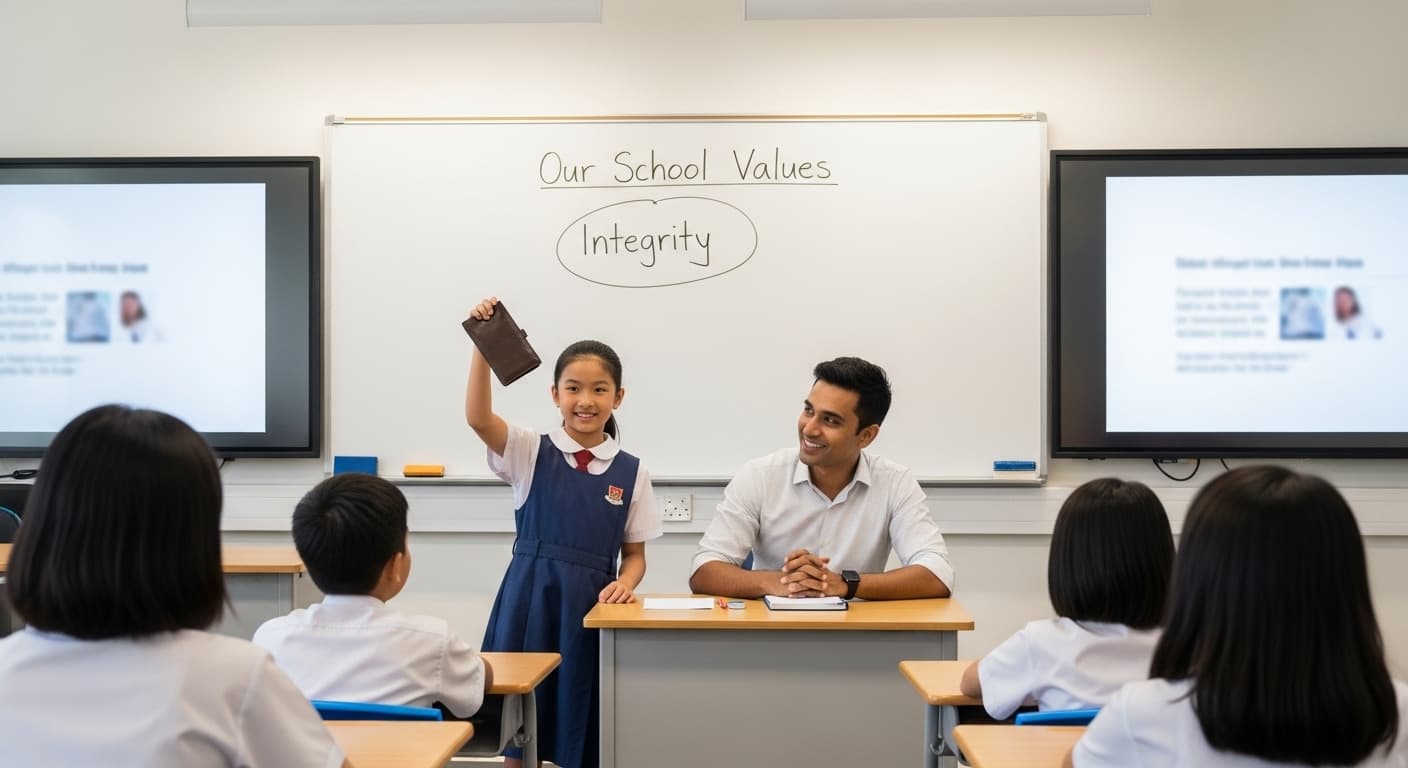
Honesty SBCs test reasoning, not slogans. The high-scoring Q3 names what happens in a school without honesty — broken trust, groups falling apart — not that honesty is 'important'.