
What the examiner sees
Photograph description
The photograph shows a class of primary school students on a field trip to a nature reserve. A male teacher stands in the middle of a wooden boardwalk, pointing up at something in the tree canopy. Two students beside him are looking through binoculars, while three others are holding tablets to take photos and notes. They are surrounded by lush green rainforest on both sides.
Three questions the examiner might ask
Look at the photograph. What are the students and teacher doing? What can you tell about the setting?
Tell me about an interesting field trip or outdoor learning experience you have had.
Do you think students learn better in a classroom or outdoors? Why?
Q1 tests what you see in the photograph. Q2 tests a personal experience. Q3 tests your opinion — the hardest of the three since 2025.
A model opinion answer (P.E.E.L.)
Point
I think working in a group is more useful than working alone, but only when the group is well-organised.
Explain
A good group is faster and brings more ideas, but a messy group slows everyone down.
Example
During our last science project, our team split the work — one person researched, one built the model, and two of us wrote the script. We finished in two sessions instead of five.
Link
So the benefit of group work isn't automatic — it depends on how clearly the group divides the work.
Swap in your own example — the structure stays the same. Examiners reward concrete detail over polished phrasing.
Common mistakes on this topic
- 'Group work is always great.' It isn't. Admit the hard parts — different paces, disagreements — and show how you handled them.
- Claiming to do all the work yourself in group projects. Humility scores higher than bragging.
- Giving textbook definitions. Describe a real class or real project you were in.
Vocabulary that works for this topic
collaborate— to work together
“We collaborate on the science project every week.”
perspective— a way of seeing things
“Group work brings different perspectives.”
responsibility— what you're accountable for
“Each of us has a clear responsibility.”
disagreement— when people don't share a view
“Our disagreement helped us find a better idea.”
contribution— what you give to the group
“Her contribution was the best design.”
engaged— fully focused
“The students were engaged in the activity.”
For parents
After school, ask 'What was the hardest part of group work today — and what did you do about it?'. That question triggers the exact kind of concrete story that Q3 loves.
Practise this topic now
Run a full Stimulus-Based Conversation on “Outdoor Learning” with an AI examiner.
Three real opinion questions, instant scoring on the 2025 SEAB rubric, and a parent-friendly breakdown of what to improve. Free for your first 10 sessions.
Practise this topic freeSign in takes 10 seconds · No credit card
Not ready to sign in? Try the free 3-minute diagnostic →
More topics in School & Education

Teamwork in School
Almost every student will say group work is great. The ones who score higher admit the hard parts — different paces, disagreements — and describe how they handled them.

Reading and Books
Reading-and-books Q3 often pushes on print vs digital. A crisp preference plus a real example wins over 'both have pros and cons'.
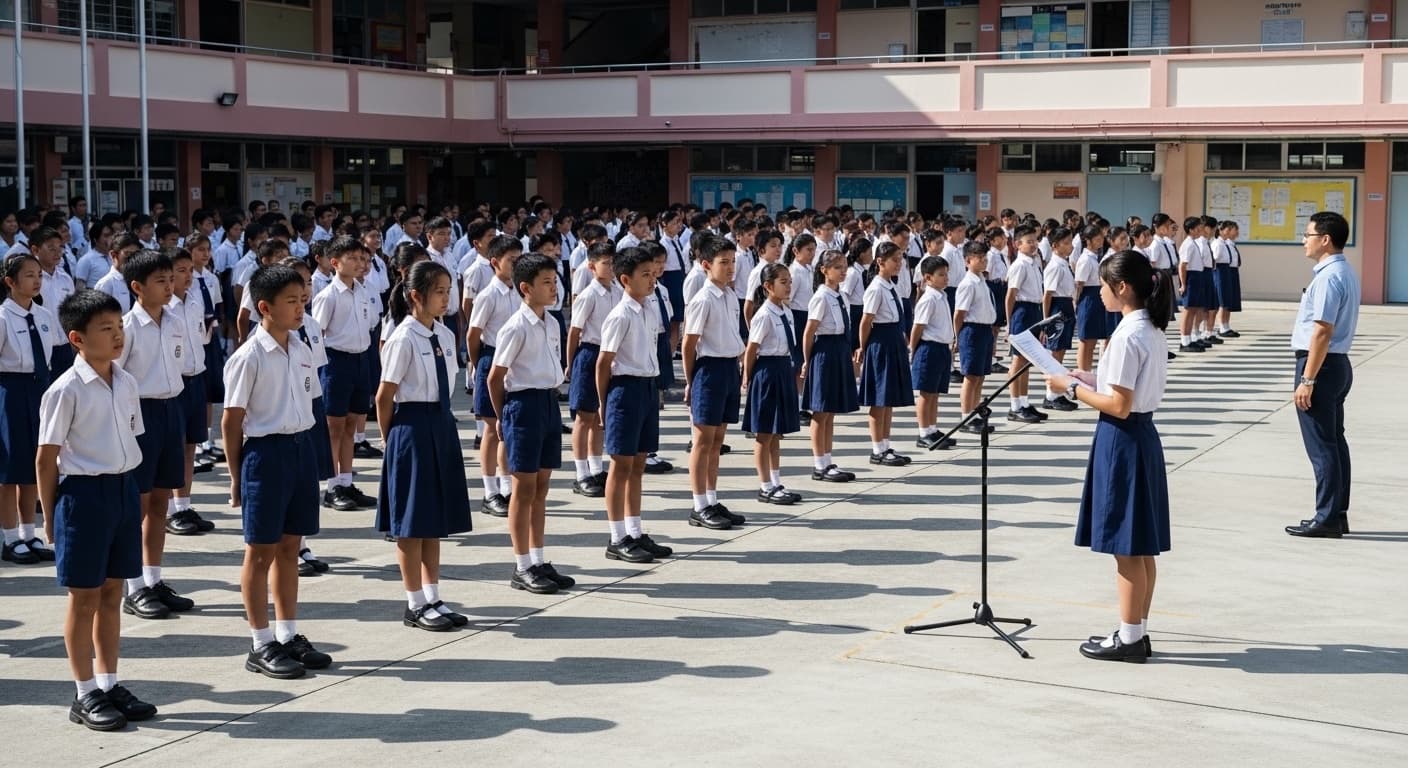
Morning Assembly
Students at a school morning assembly on an outdoor parade square.

In the Science Lab
Two students working in a school science laboratory.