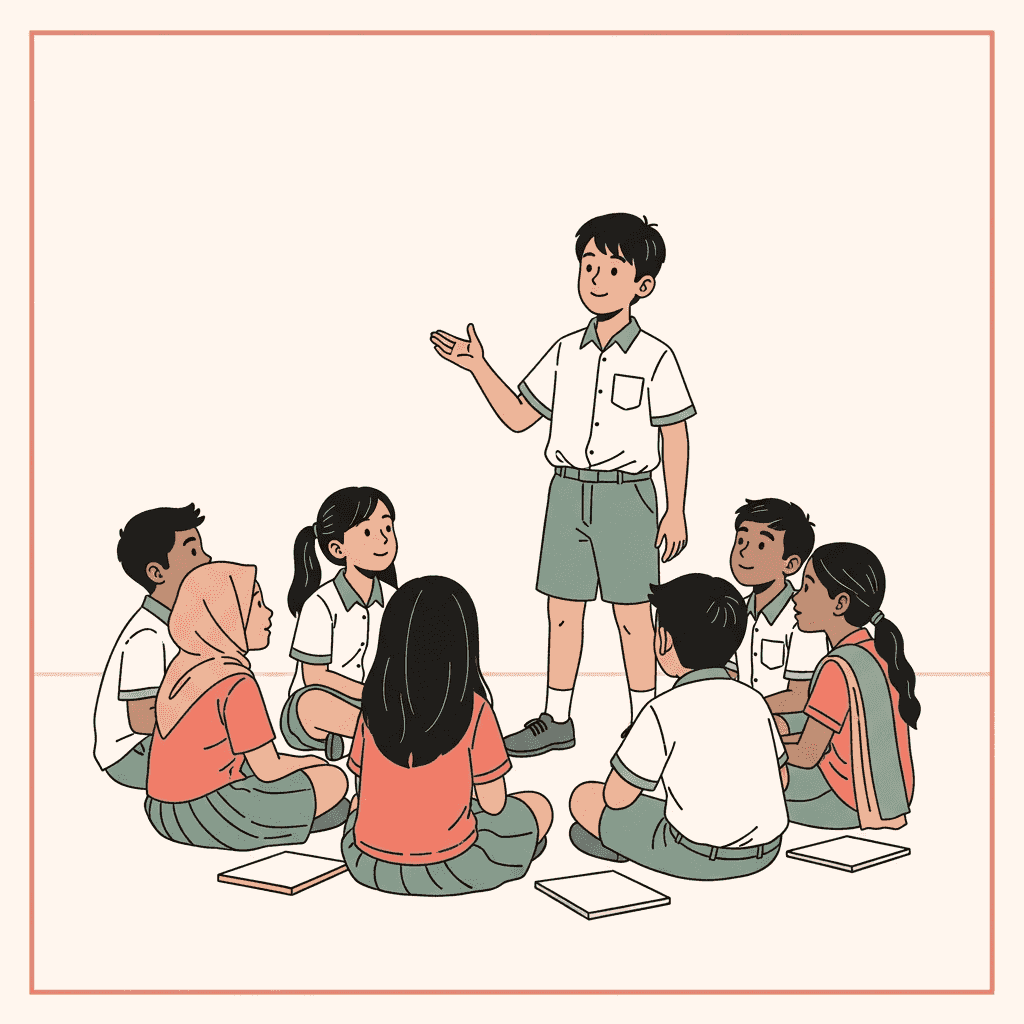
What is being assessed
What does a leadership DSA-Sec panel actually look for?
A leadership panel is listening for a decision your child actually made, with a cost attached. Titles are already on the application. What is not on the application is how the child handled disagreement, what they did when a plan failed, and whether they can lead without needing to dominate.
- A real decision, with the consequence attached. Not “I organised a drive” but what your child decided when two people wanted different things and one of them had to be disappointed.
- How disagreement was handled — with a peer, and with an adult. The reported question set in this area is unusually heavy on conflict.
- Whether the child notices other people. Drawing out a quieter teammate is a repeatedly named signal, though it comes from preparation material rather than any school's published rubric.
- Service rather than status. Roughly a third of the leadership entries in MOE's data are labelled community youth leadership, which points at service work rather than school office.
- Composure while observed. Group stages are common here, and the child is being watched between the tasks as well as during them.
Panels are listening for a real decision your child made, not a list of titles held.
The field
Which secondary schools offer leadership as a DSA-Sec talent area?
Leadership is offered by 77 of the 143 secondary schools publishing DSA-Sec talent areas — 82 entries, of which 51 are labelled simply “Leadership” and 26 “Community Youth Leadership”. It is the most widely spread non-sporting talent area in the scheme.
Schools offering leadership
77 of 143
PSLEPrep extraction from MOE SchoolFinder, 8 August 2026
Talent-area entries
82
Leadership 51 · Community Youth Leadership 26 · Leadership and Character 4 · Service Leadership 1
IP schools in this category
12
Counted across leadership and uniformed groups together
Where the interview is the only stage
Some schools
At least one school publishes leadership as interview-only, while others publish trials
That spread is the strategic fact for a leadership family. Because more than half of all secondary schools offer it, the constraint on your school list is rarely availability — it is fit. And the two dominant labels point in genuinely different directions: a school offering community youth leadership is signalling service and community work, while a school offering leadership and character is signalling something closer to school office and conduct. Four schools use that second label; one uses “service leadership”. It is worth reading which one your target schools chose.
Reported questions
What questions come up in leadership DSA-Sec interviews?
Reported leadership questions cluster around conflict and authority: a leader you disagreed with, a team member who would not contribute, peers who did not respect your role. Very few are about achievement, and almost none about the titles listed on the form.
How to read the labels
- Confirmed
- A school has published this task or probe in its own DSA document. Only that it exists — and what the school says it is for — is confirmed. The wording below is ours.
- Corroborated
- Described first-hand by a parent or candidate who was in the room. Anecdote, but from someone who was actually there.
- Unverified
- Circulates in tuition question banks or guides with nothing behind it, or rests on a single second-hand report. Worth rehearsing. Not evidence that any school asks it.
Leadership has the largest circulating question bank of any talent area and one of the thinnest evidence bases behind it. These are the ones tagged to leadership in our main bank — note how many are about conflict rather than achievement, which is the consistent shape across every list we reviewed.
“Tell us about a time you led a team through something difficult. What did you learn?”
Unverified- Why they ask it:
- Leadership talent areas cannot be trialled the way a sport can, so the story is the evidence. The panel is listening for a real group with real friction in it.
- The weak answer:
- Choosing a story where everything went well. Nothing was led if nothing went wrong. The learning at the end should be specific enough that it could not be pasted onto a different story.
- Where this comes from:
- Commercial question bank, unattributed, and near-identical to versions on several other prep sites.
“How do you make sure the quieter people in a group get a chance to contribute?”
Unverified- Why they ask it:
- Group tasks and group interviews are widely used and almost never described from the inside. This question is the market's best guess at what they measure.
- The weak answer:
- Describing what a good leader should do in general. The answer needs one occasion, one quiet person, and what the child actually said to them.
- Where this comes from:
- Commercial question bank. Note a real tension in the evidence: prep sites assume group rounds reward 'leading without dominating', while the one school document we read states its group interview assesses commitment and motivation. The market's assumption may simply be wrong for some schools.
“What leadership roles have you held in primary school, and what did you actually do in them?”
Corroborated- Why they ask it:
- The second half is the real question. Titles are easy to collect; the panel wants the duties behind the badge.
- The weak answer:
- Listing positions. Prefect, class monitor, CCA committee — none of it means anything without one concrete thing the child was responsible for.
- Where this comes from:
- Reported first-hand as part of a 2024-cycle visual-arts session, where leadership questions appeared alongside talent questions.
“Your group project isn't going well because two people aren't contributing. What do you do?”
Unverified- Why they ask it:
- Conflict handling in a low-stakes setting every child recognises. The answer shows whether their instinct is to tell a teacher, do it themselves, or talk to the person.
- The weak answer:
- Doing everyone's work and calling it leadership. Panels hear that answer constantly and it describes a child who will burn out, not lead.
- Where this comes from:
- Commercial question bank, unattributed.
“You find out a close friend was dishonest to get a position in a CCA. What do you do?”
Unverified- Why they ask it:
- Loyalty against integrity, with no comfortable answer available. The panel wants to see the child sit inside the difficulty rather than escape it.
- The weak answer:
- The instant report to a teacher, or the instant loyalty to the friend. Both skip the hard part. Naming that both matter, and then choosing anyway, is the answer.
- Where this comes from:
- Commercial question bank, unattributed.
A few more, specific to this talent area
Four more that recur in leadership specifically. All of them come from preparation material rather than from anyone who was in the room, which the tier on each says plainly.
“What is the difference between a leader and a boss? Which would you rather be?”
Unverified- What it is probing:
- Whether the child has thought about authority at all. It is answerable badly in a hundred ways and well in about three.
- Where this comes from:
- Commercial question bank marketed as real questions, with no attribution.
“Have you ever had to follow a leader you disagreed with? How did you handle it?”
Unverified- What it is probing:
- Followership. Every DSA-Sec leadership entrant will spend Year 1 being led by older students.
- Where this comes from:
- Same commercial bank. Unsourced but consistently repeated.
“You are given a role, but some of your peers do not respect your authority. What do you do?”
Unverified- What it is probing:
- The realistic answer usually involves doing something rather than announcing something.
- Where this comes from:
- Same commercial bank. Unsourced.
“What qualities make a good leader in a secondary school CCA?”
Unverified- What it is probing:
- An invitation to generalise, which is a trap. The strong version names a quality and immediately grounds it in someone the child has actually watched lead.
- Where this comes from:
- Same commercial bank. Unsourced.
Questions about the child themselves, and the “why our school” and rank-order questions, apply to every talent area. They live on the main question bank rather than here.
The process
What are the selection stages for leadership DSA-Sec applicants?
Leadership is assessed in more different ways than almost any other talent area. Published school material describes personal statements, group activities, selection trials, one-stage interviews and multi-round processes — sometimes at schools of very similar profile. Guessing one school's format from another's is the commonest mistake families make here.
1.A personal statement
ConfirmedRaffles Institution publishes that its Leadership and Character domain is assessed by personal statement, group activity and interview together. Nanyang Girls' High School publishes a matrix showing Service Leadership assessed by personal statement and interview, with no trial and no selection test. A conditional offer following a personal statement submission was also reported by a parent.
Read from each school's own published admissions material for the 2026 exercise.
2.A group activity or first-round group session
ConfirmedOne school publishes a group activity as a named component of its leadership selection. Parents describe a first-round group session at another school, with a further round for those who progressed, and staggered timeslots on the day. What happens inside these sessions is essentially undocumented — the format is confirmed, the content is not.
School-published material for the component; forum accounts for the round structure.
3.Selection trials for leadership
UnverifiedParents in recent cycles report several schools running selection trials for their leadership talent areas rather than interviews. What a leadership trial consists of is not described anywhere we could find.
Forum accounts only. Named schools were reported but we do not repeat them, because the claim is unverified.
4.The interview
ConfirmedAt some schools the interview is the whole assessment: one school publishes leadership as interview-only while assessing its other domains by trial, test or audition. Elsewhere it is the last of three stages. One school publishes a group interview as a mandatory second gate for every talent area, with the stated purpose of assessing commitment and motivation level — a narrower criterion than the collaboration-and-influence framing the preparation market assumes.
Read from schools' own published DSA-Sec documents. The last point is quoted from a published table, not inferred.
Formats vary far more than most families expect. The DSA-Sec interview guide covers what happens in the room across every talent area.
Worked answers
How should your child actually answer these?
Leadership sessions turn on three answers: one decision with a cost, one disagreement handled well, and one honest account of a time your child was not the leader. The third is the one nobody prepares and the one that lands.
The decision with a cost
Tell us about a time you led something.
Choose an occasion where two things could not both happen and your child decided. Say what was given up. A decision with no cost is an announcement, and panels hear a hundred announcements.
“We were doing a food drive and we only had two trolleys. My friend wanted to do the whole block on one afternoon and I said no, because the Primary 4s would have had to carry things down four flights. So we split it over two Saturdays instead. It meant fewer people came on the second day and we collected less than we wanted — but nobody dropped out, and we still go back now.”
The admission that they collected less is what makes the rest believable. Children want to remove that sentence. Leave it in.
The disagreement
Have you ever had to follow a leader you disagreed with? How did you handle it?
Say what the disagreement was about, what your child did privately, and what they did publicly. The strong version usually involves raising it once, properly, and then supporting the decision anyway.
“Our captain wanted us to practise the whole routine every session and I thought we should split it up. I told her after training, not in front of everyone, and she said no. So I did it her way for the rest of the term. Near the end she tried splitting it for one week and it was better, and she said so. I don't think I'd have got that if I'd argued in front of the group.”
This answer shows followership, timing and restraint in one story. Those three are harder to fake than enthusiasm.
The time you were not in charge
Tell us about a team you were part of but did not lead.
Almost nobody prepares this, and it is the fastest way to sound like a real person. What did your child do to make someone else's job easier?
“In our class play I wanted to be the narrator and I didn't get it. I ended up doing props. The narrator kept losing her place because the script was in one big block, so I cut it up and taped it to the back of the boards where she stood. She didn't ask me to. It was the most useful thing I did the whole term.”
A leadership panel that hears this has learned more than it would from three prefect stories.
The common failure
What is the weakest common answer in leadership DSA-Sec interviews?
The weakest common answer in leadership is the title list — a recitation of roles held, delivered as evidence. It fails because every other candidate has one, it is already on the application form, and it contains no decision at all.
The title list
“I was a prefect in Primary 5 and 6, I'm the class chairperson, I was the vice-captain of my CCA, and I helped organise our school's charity week.”
Why it falls flat. It answers a question nobody asked. The panel can read the form. With seventy-seven schools offering leadership and every applicant arriving with a comparable list, the roles are the flat part of the field. The list also has a second problem: it invites the follow-up “what did you actually do?”, which is the question the child should have answered first.
What to do instead. One occasion, told in order: what was at stake, what your child decided, who was unhappy about it, what happened afterwards. If the story has no unhappy person in it, it is probably not a decision.
This week
What should your child practise this week?
Find three stories, not thirty answers: a decision with a cost, a disagreement handled well, and a time your child helped without being in charge. Then practise being interrupted mid-story, because group stages rarely let anyone finish, and recovering gracefully from that is a trainable skill.
Leadership preparation goes wrong when it becomes rehearsal. The aim is for your child to have material they know well, not lines they can recite.
1.Hunt for the three stories
Sit down and find them together. Most children have them and have never thought of them as leadership — the useful ones are usually small and specific rather than titled.
2.Add the cost
For each story, ask: who was disappointed, and what did we not get? A child who can answer that is describing a decision. A child who cannot is describing an activity.
3.Practise being interrupted
Cut your child off in the middle of a story and ask something else. Group activities and panel sessions do this constantly, and recovering gracefully is a trainable skill.
4.Prepare the not-in-charge answer
Almost no one does, which is exactly why it works. One occasion where your child made someone else's job easier.
5.Check what your schools actually assess
Leadership is assessed by personal statement at some schools, group activity at others, trials at a few and interview alone at others again. Read each school's published page — this is the talent area where guessing is least safe.
Practising the speaking itself
Leadership selection is the talent area most completely made of talking — a statement read aloud, a group discussion, an interview. There is no trial that can speak for your child. Spoken practice is the preparation.
PSLEPrep’s free three-minute diagnostic is built for the PSLE English oral, not for DSA-Sec, and it does not simulate any school’s selection process. It is simply a way to hear how your child sounds answering a question out loud.
Try the free 3-minute speaking diagnostic →The DSA-Sec Interview Preparation Pack — coming soon
We are still writing it, so leave your email and we will send it the day it is done rather than send you something half-finished. A free guide for parents: how the DSA-Sec selection process works, the kinds of question interviews tend to explore, and how to help your child practise talking about their own interests and work — drawn from MOE’s published DSA-Sec framework.
- Question archetypes and the thinking behind them, with worked examples we wrote ourselves.
- What the process actually involves, stage by stage, and where to find each school’s own published details.
- Early access to our DSA-Sec interview practice tool, expected November–December 2026.
These are not real questions from any school, and we neither publish nor ask for actual interview content. DSA-Sec selection decisions are made entirely by each school, on its own criteria, and no preparation can guarantee an interview or an offer. What preparation can do is narrower: help a child speak clearly and honestly about work that is genuinely their own. PSLEPrep is independent and is not affiliated with, endorsed by, or connected to the Ministry of Education or any school.
Questions parents ask
Leadership DSA-Sec: common questions from parents
- Does my child need to have been a prefect to apply for leadership DSA-Sec?
- No school we checked publishes a title requirement. Published criteria tend to describe sustained participation, character, service and evidence of responsibility rather than office held. At least one school publishes that applicants without prior experience may apply and will be assessed on potential.
- What is a leadership group activity, and what happens inside it?
- We do not know, and neither does anyone publishing about it. One school names a group activity as a formal component and another runs a group first round, but no first-hand account of what happens inside one exists in the public record. What is repeatedly claimed — that panels reward leading without dominating — comes entirely from preparation material. One school's published criterion for its group stage is narrower than that: commitment and motivation.
- What is the difference between Leadership and Community Youth Leadership?
- MOE's data records them as separate talent areas — 51 entries for the first and 26 for the second — but the substance is set by each school, not by MOE. In practice the community label points towards service work beyond the school, and the school's own DSA-Sec page will describe what it is looking for. It is worth reading before choosing which to apply under.
- Is a personal statement required?
- At some schools, yes, and it is published as a named component. One school lists personal statement, group activity and interview together for its leadership domain; another lists personal statement and interview with no trial. Where it is required it is usually the child's own writing, and a statement that does not sound like the child in the room is a liability rather than an asset.
- How competitive is leadership compared with other talent areas?
- We do not publish offer rates or success rates for any talent area, and you should be sceptical of anyone who does. What can be said from MOE's data is that leadership is offered by more than half of all secondary schools, so availability is rarely the constraint. The constraint is that most applicants look similar on paper.
- Will my child be asked about current affairs?
- Possibly. Broad questions about issues facing Singapore appear across circulating question lists for this area, though almost none of them trace to a first-hand account. Reading a newspaper with your child two or three times a week is reasonable preparation; drilling model opinions is not, and it tends to produce answers that sound borrowed.
- What happens if my child stops holding leadership roles later?
- Published school documents state that a DSA-Sec student must take part in activities related to their talent from Year 1 to Year 4, cannot join S1 Posting, and cannot transfer after PSLE results, with at least one school stating plainly that it will not accept appeals. For leadership that usually means a sustained commitment to student leadership or service across four years.